Corporation tax calculator with marginal relief
Enter your company’s taxable profits and its accounting period. You get the corporation tax to pay, the marginal relief, the rate it works out at and HMRC’s workings line by line, for 2026/27 and earlier years. It works as a limited company tax calculator for associated companies, short periods and periods that straddle 1 April, and it tells you when the tax is due and when the Company Tax Return has to be filed.
Every sum runs in your browser. Nothing you type is sent to us or saved.
Year to 31 March 2027 · 365 days
corporation tax on taxable profits of £100,000, an effective rate of 22.75%.
For practices: PrepIQ prepares this computation in every limited company year-end set and posts the tax charge for your review.
Open PrepIQ Try IQ Books freeRates and limits used, checked against GOV.UK on 9 October 2026
Sources:
This is an estimate of corporation tax to help you plan, not tax advice. It starts from taxable total profits, so add-backs, capital allowances, losses and reliefs need to be in that figure already. It does not cover ring fence profits from oil extraction, close investment-holding companies (which pay the main rate whatever their profits), quarterly instalment payments, interest on late payment, or a change in the number of associated companies part-way through a period that straddles 1 April.
PrepIQ and IQ Books by ReconcileIQ
The same computation, in the year-end set
This calculator works the tax out from one profit figure. PrepIQ, our year-end working papers product for practices, builds the taxable profit from the client’s records first and then computes the tax exactly as above. IQ Books keeps a limited company’s books all year, so the profit is there when the year ends.
01
A tax computation in every year-end set
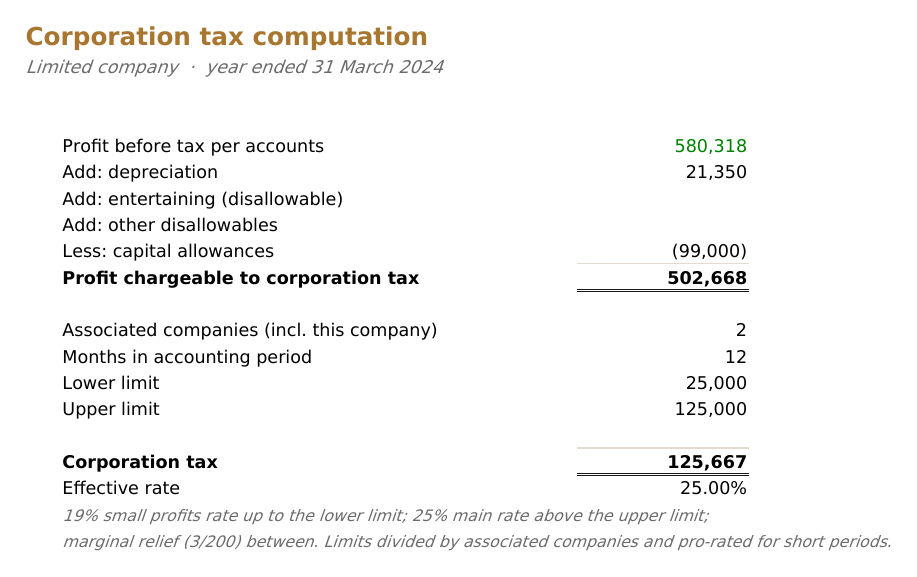
Hand PrepIQ a client’s ledger and paperwork and RiQ prepares the full set of working papers, with the corporation tax computation among them: profit per the accounts, add-backs such as depreciation and disallowable entertaining, capital allowances from their own schedule, then the banded rates, marginal relief and associated companies, apportioned across financial years.
- The tax charge posted as a year-end journal, linked back to the computation
- Every figure a live cell link, and the set ties out to a nil check row
- Memo-only if your firm prefers; it never files the CT600 for you
PrepIQ is live on the ReconcileIQ practice plans, Practice Essential and above, in the UK and Ireland. See PrepIQ.
02
The profit figure, kept as you go
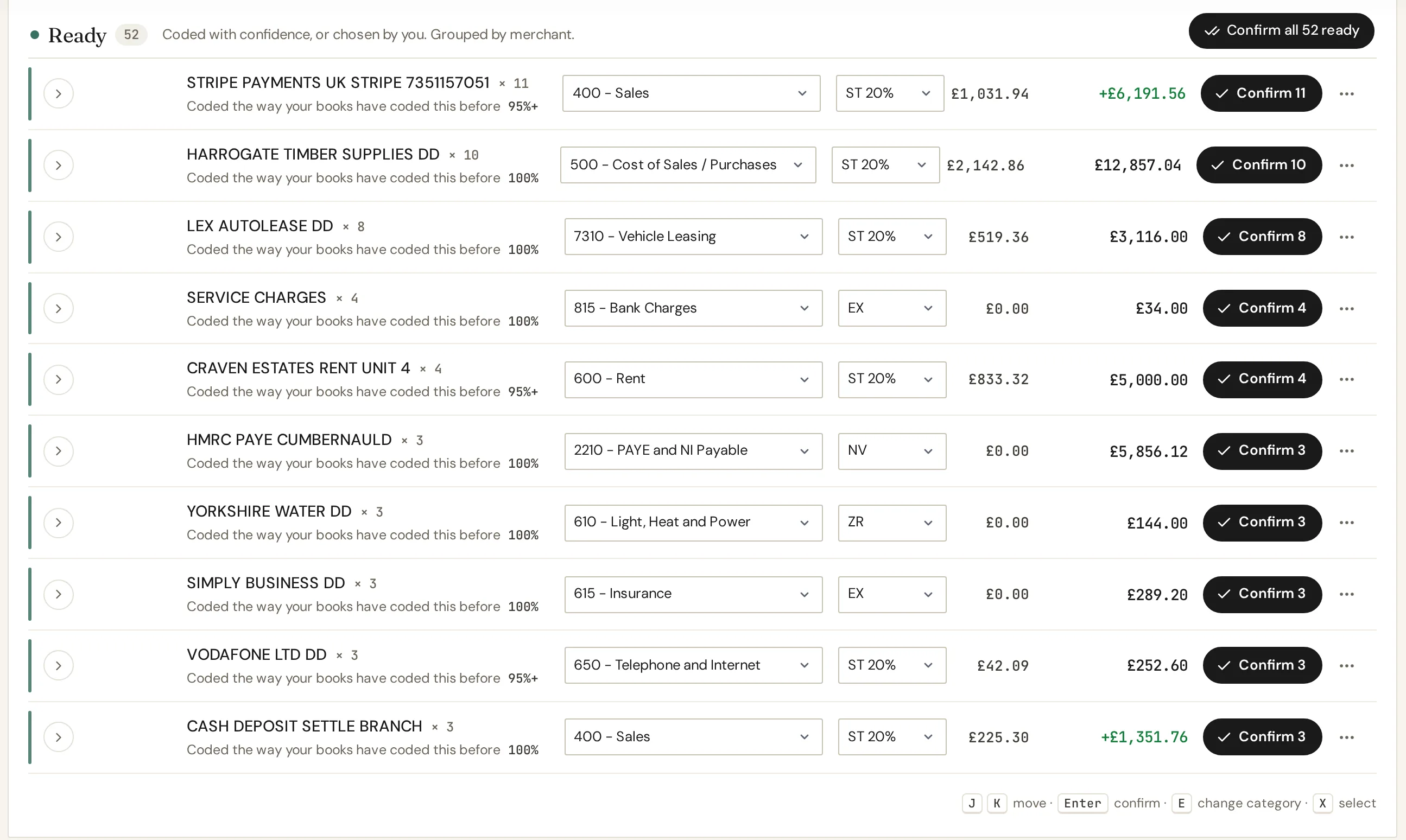
IQ Books is the accounting platform that does the bookkeeping for you. Bank lines arrive already coded by CodeIQ, its AI bookkeeper, with the account and the VAT code set, so the profit and loss is current every day rather than rebuilt at the year end. One organisation with the whole ledger, including VAT filing under Making Tax Digital, is free.
- Profit and loss and balance sheet, live from the posted books
- Bank feeds, invoices, bills and receipts in one ledger
- VAT returns built from the books and filed to HMRC
Coding by hand is always free; automatic coding draws on credits, and every account starts with 1,000. See IQ Books.
Guide
Corporation tax, worked out
The rates for 2026/27, how a limited company’s tax is calculated, the marginal relief formula with HMRC’s own examples, and when to pay and file, all checked against GOV.UK and HMRC’s Company Taxation Manual.
UK corporation tax rates for 2026/27
The corporation tax rate depends on how much profit the company makes. For the financial year that started on 1 April 2026 (FY2026, often written 2026/27), the main rate of corporation tax in the UK is 25%, and the corporation tax rate for small companies, the small profits rate, is 19%. A company with profits between £50,000 and £250,000 pays the main rate, reduced by marginal relief. The current rate of corporation tax has not changed since 1 April 2023, and nor have the limits.
| Financial year | Small profits rate | Main rate | Lower limit | Upper limit | Fraction |
|---|---|---|---|---|---|
| 2026 (1 Apr 2026 to 31 Mar 2027) | 19% | 25% | £50,000 | £250,000 | 3/200 |
| 2025 (1 Apr 2025 to 31 Mar 2026) | 19% | 25% | £50,000 | £250,000 | 3/200 |
| 2024 (1 Apr 2024 to 31 Mar 2025) | 19% | 25% | £50,000 | £250,000 | 3/200 |
| 2023 (1 Apr 2023 to 31 Mar 2024) | 19% | 25% | £50,000 | £250,000 | 3/200 |
| 2015 to 2022 | 19% on all profits | No marginal relief | |||
The rate for the financial year that starts on 1 April 2027 has not been set yet. If your accounting period runs past that date, the calculator applies the 2026 figures to those days and says so. The same corporation tax rates apply across the UK, including Scotland, Wales and Northern Ireland.
How much tax does a limited company pay?
Tax on a limited company starts with corporation tax, which is charged on taxable profits, not on turnover. Start from the profit in the accounts, add back the costs the tax rules do not allow (depreciation and client entertaining are the usual ones), take off capital allowances, and you have the profit chargeable to corporation tax. To calculate limited company tax from there, for a 12-month period with no associated companies:
- Profits of £50,000 or less: 19%. On £40,000 the company pays £7,600.
- Profits between £50,000 and £250,000: 25%, less marginal relief. On £100,000 the company pays £22,750, an effective rate of 22.75%.
- Profits over £250,000: 25% on all of it. On £300,000 the company pays £75,000.
That is the company’s own tax. What the directors and shareholders take out is taxed again as their income: a salary is a cost to the company and goes through PAYE, while dividends are paid out of profit after corporation tax and taxed on the shareholder. If you are weighing up a company against working for yourself, our self-employed tax calculator works out the other side.
Corporation tax marginal relief: the formula
The corporation tax marginal relief calculator above does this for you. To calculate marginal relief by hand, HMRC’s formula, in its Company Taxation Manual at CTM03925, is:
Marginal relief = F × (U − A) × (N ÷ A)
F is the standard fraction, 3/200. U is the upper limit, £250,000 for a 12-month period. N is the company’s taxable total profits. A is its augmented profits: taxable profits plus any exempt dividends received from companies outside its group. Most small companies receive no such dividends, so A and N are the same and the formula shortens to 3/200 × (£250,000 − profits).
Worked through for profits of £100,000: tax at the main rate is £100,000 × 25% = £25,000. Marginal relief is 3/200 × (£250,000 − £100,000) = £2,250. Corporation tax is £25,000 − £2,250 = £22,750.
HMRC’s own example has dividends in it. A company with taxable profits of £90,000 and £8,000 of exempt dividends has augmented profits of £98,000. Tax at 25% is £22,500; marginal relief is 3/200 × (£250,000 − £98,000) × (£90,000 ÷ £98,000) = £2,094; so the tax is £20,406. The dividends are not taxed, but they push the company further into the band and reduce the relief.
Between the limits, each extra pound of profit costs 26.5p: the 25% main rate plus the 1.5p of relief that is lost. That marginal rate of 26.5% is why the band from £50,000 to £250,000 is the most expensive place for the next pound of profit.
Associated companies
If a company has associated companies, the £50,000 and £250,000 limits are shared: both are divided by one plus the number of associated companies. With three associated companies the limits are divided by four, to £12,500 and £62,500. A company is associated with another if one controls the other, or both are controlled by the same person or group of people. An associated company counts even if it was associated for only part of the accounting period, but one that carried on no trade or business during the period is ignored.
Short accounting periods, and periods that straddle 1 April
For an accounting period shorter than 12 months, the limits are reduced in proportion. HMRC’s manual uses 9/12 in its example for a nine-month period and notes that, strictly, the reduction goes by days, which is what this calculator does. For a nine-month period from 1 January to 30 September 2024 with profits of £55,000, that gives £11,762.48 against £11,762.50 by months.
A corporation tax financial year runs from 1 April to 31 March. When an accounting period crosses 1 April and the rules differ either side, HMRC treats the two parts as separate periods: the profits are split by the length of the accounting period, and each part is tested against the limits for its own financial year, pro-rated by the days of that year. HMRC’s example is a calendar year 2023 with profits of £175,000 and two associated companies: £43,151 falls before 1 April 2023 at the old single rate of 19%, and £131,849 after it, above the reduced upper limit, at 25%, for corporation tax of £41,160.94. The calculator gives the same figure.
When to pay and when to file
Corporation tax is due nine months and one day after the end of the accounting period. For a period that ends on the last day of a month, that is the first day of the tenth month: a year to 31 March 2027 pays by 1 January 2028, and a year to 30 June 2026 by 1 April 2027. HMRC does not send a bill, so the company has to work the tax out and pay it on time. Companies with taxable profits over £1.5 million usually pay in quarterly instalments instead.
The Company Tax Return, form CT600, is due 12 months after the end of the accounting period, with the company’s accounts and the tax computation. It is filed online, and it is due even when there is no tax to pay. HMRC’s late filing penalties are £200 for a return one day late and another £200 at three months; at six months HMRC estimates the tax and adds 10% of anything unpaid, and another 10% at 12 months. If a return is late three times in a row, the £200 penalties become £1,000 each.
Rates, limits and rules checked against GOV.UK on 9 October 2026: Rates and allowances: Corporation Tax, Corporation Tax rates and reliefs, Marginal Relief for Corporation Tax, HMRC’s Company Taxation Manual at CTM03925, CTM03915, CTM03930, CTM03940, CTM03955 and CTM01800, Pay your Corporation Tax bill, Company Tax Returns and penalties for late filing. This calculator is a guide to the arithmetic, not tax advice.
Questions
Corporation tax, answered
About the rates, marginal relief, deadlines, this calculator, and what PrepIQ does with the computation.
What is the UK corporation tax rate for 2026/27?
For the financial year starting 1 April 2026, the main rate of corporation tax in the UK is 25%, for companies with profits over £250,000. The small profits rate is 19%, for profits of £50,000 or less. Between the two, the company pays the main rate less marginal relief. These are the same rates and limits that have applied since 1 April 2023.
How do I calculate corporation tax?
Start from taxable profits, not turnover: profit after allowable expenses, capital allowances and tax adjustments. If those profits are £50,000 or less, multiply by 19%. If they are over £250,000, multiply by 25%. In between, multiply by 25% and take off marginal relief, which is 3/200 × (£250,000 − profits). Reduce both limits if the accounting period is shorter than 12 months or the company has associated companies. The calculator above does all of this and shows each line.
Is corporation tax based on turnover or profit?
Profit. Corporation tax is charged on a company's taxable total profits: its trading profit after allowable expenses and capital allowances, plus any investment income and chargeable gains. A company with high turnover and a loss pays no corporation tax for the period.
What is marginal relief?
Marginal relief is the deduction that eases the step from the 19% small profits rate to the 25% main rate. It applies when a company's profits are between the lower limit of £50,000 and the upper limit of £250,000. The company works out tax at 25% and then takes the marginal relief off, so the overall rate rises gradually instead of jumping at £50,000.
How is marginal relief calculated?
HMRC's formula is 3/200 × (upper limit − augmented profits) × (taxable profits ÷ augmented profits). Without any dividends received, augmented profits and taxable profits are the same, so it simplifies to 3/200 × (£250,000 − profits). On profits of £100,000 that is 3/200 × £150,000 = £2,250, so the tax is £25,000 − £2,250 = £22,750.
How is marginal relief calculated for associated companies?
Divide both limits by one plus the number of associated companies, then apply the same formula. With three associated companies the limits are divided by four, to £12,500 and £62,500. A company with profits of £60,000 then pays £15,000 at 25% less marginal relief of 3/200 × (£62,500 − £60,000) = £37.50, so £14,962.50.
What is the marginal rate of corporation tax?
Between the £50,000 and £250,000 limits, each extra pound of profit costs 26.5p in corporation tax: the 25% main rate plus the 1.5% (3/200) of marginal relief that is lost as profits rise. Below £50,000 the rate on each pound is 19%, and above £250,000 it is 25%.
How much tax does a limited company pay?
On a 12-month period with no associated companies: 19% of profits up to £50,000, so £7,600 on £40,000; 25% less marginal relief between £50,000 and £250,000, so £22,750 on £100,000, an effective rate of 22.75%; and a flat 25% above £250,000, so £75,000 on £300,000. Salary and dividends the directors take out are taxed separately, as their own income.
When is corporation tax due?
Nine months and one day after the end of the accounting period. For a period ending on the last day of a month, that is the first day of the tenth month after it: a year to 31 March 2027 pays by 1 January 2028. Companies with taxable profits over £1.5 million usually pay in quarterly instalments instead. HMRC does not send a bill; the company works the tax out and pays it.
When is a limited company tax return due?
The limited company tax return deadline is 12 months after the end of the accounting period the return covers, which is after the tax has to be paid. The return is form CT600. Filing one day late costs £200, and another £200 at three months. At six months HMRC estimates the bill and adds 10% of the unpaid tax, and another 10% at 12 months. If a return is late three times in a row, the £200 penalties become £1,000 each.
Is this the same as HMRC's marginal relief calculator?
It follows the same rules, from HMRC's Company Taxation Manual: the 3/200 fraction, limits pro-rated by days and divided by associated companies, and periods split at 1 April. It also shows the workings, the payment and filing dates and the rates it used. The HMRC marginal relief calculator itself is linked from HMRC's marginal relief guidance on GOV.UK.
Is corporation tax different in Scotland, Wales or Northern Ireland?
No. The same corporation tax rates and limits apply across the UK. Scotland sets its own Income Tax bands for individuals, but not corporation tax, so a company registered in Scotland, Wales or Northern Ireland uses this calculator in the same way.
Does PrepIQ calculate corporation tax?
Yes. In every limited company year-end set, PrepIQ prepares the corporation tax computation from the accounts: add-backs, capital allowances, the banded rates, marginal relief and associated companies, apportioned across financial years. It posts the tax charge as a year-end journal, unless your firm profile says to keep the computation as a memo only. It does not file the CT600; the computation feeds your tax software.
Does this calculator store or send my figures?
No. Every sum runs in your browser. Nothing you type is sent to ReconcileIQ or anyone else, and nothing is saved when you close the page.
The computation, done in the year-end set.
PrepIQ prepares the working papers and the corporation tax computation from a client’s records, ready for your review. IQ Books keeps a company’s books all year, and one organisation with the whole ledger is free.