Free profit and loss template for UK businesses
A free profit and loss statement template, the income statement template UK businesses use, filled in online. Fill in a profit and loss account here and it lays itself out as you type: turnover, cost of sales and gross profit, the expenses, then operating profit, interest and tax down to the profit for the year, with the margins worked out. Switch between a limited company and a sole trader, keep last year alongside, and download the P&L template as Excel with live formulas, a CSV or a PDF.
Everything runs in your browser. Nothing you type is sent to us or saved.
Profit and Loss Template
Start with the turnover, then cost of sales and the expenses. The statement builds as you type.
Get the P&L from the books. IQ Books produces the profit and loss account live from what you post, for any period, free for one organisation.
Try IQ Books freeThis free profit and loss template lays out and adds up the figures you enter. It is not a set of statutory accounts: a limited company’s accounts follow the Companies Act formats and accounting standards, and its tax comes from a separate corporation tax computation. The figures are only as good as the ones you type in.
IQ Books by ReconcileIQ
The same P&L, from the books themselves
This template is the profit and loss account on paper. IQ Books produces it from the ledger: every sale, bill and bank line you post lands in its line, so the profit and loss account is current whenever you look, and every figure links back to the transactions behind it.
01
A live P&L, for any period
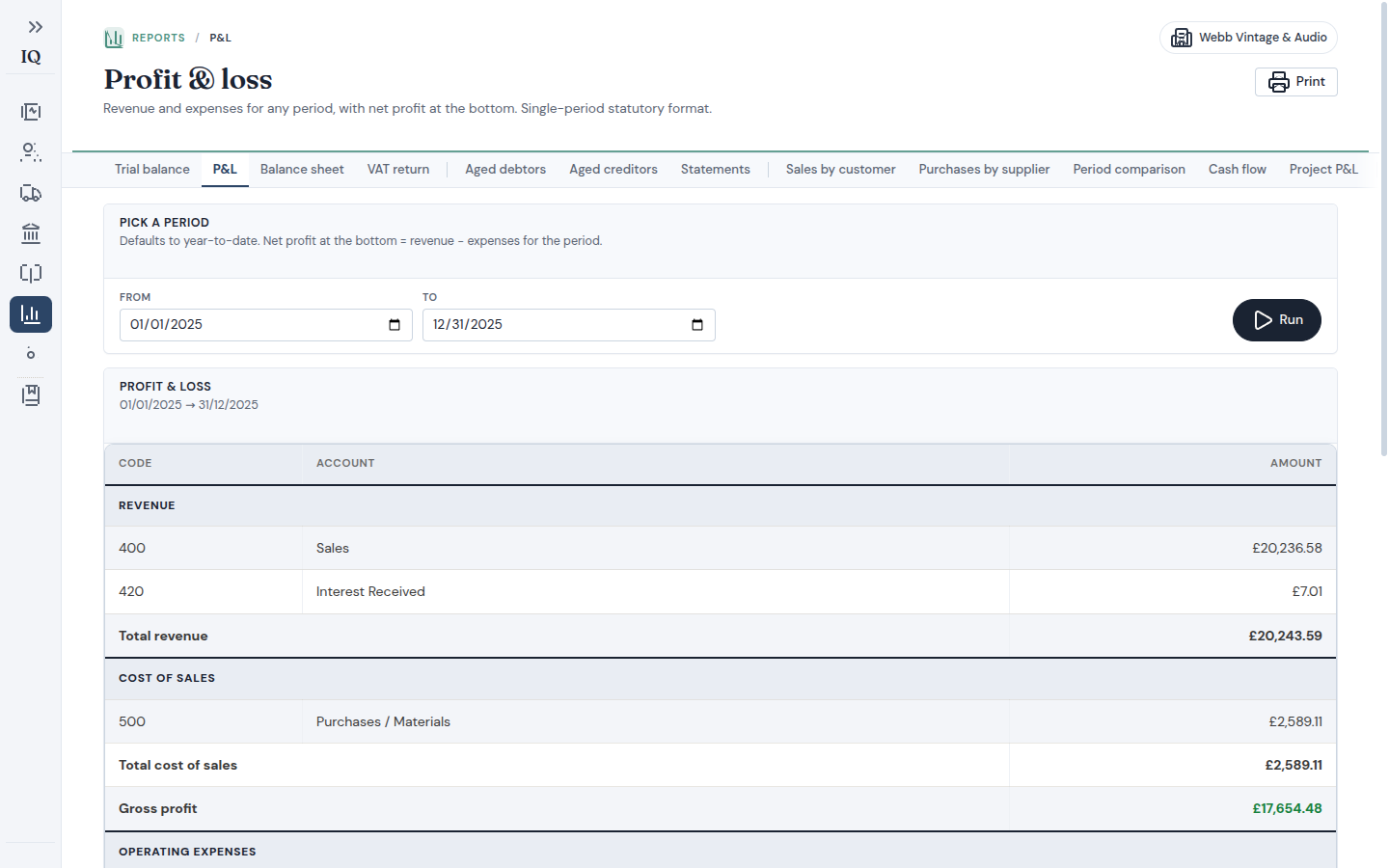
Pick a period and run it: revenue, cost of sales and gross profit, the operating expenses and net profit, in a single-period statutory format. A period comparison report sets this year against last, and every value drills down to its transactions.
- Any period, year to date by default
- Period comparison against last year
- Drill from any figure to the transactions
02
Statutory accounts from the same ledger
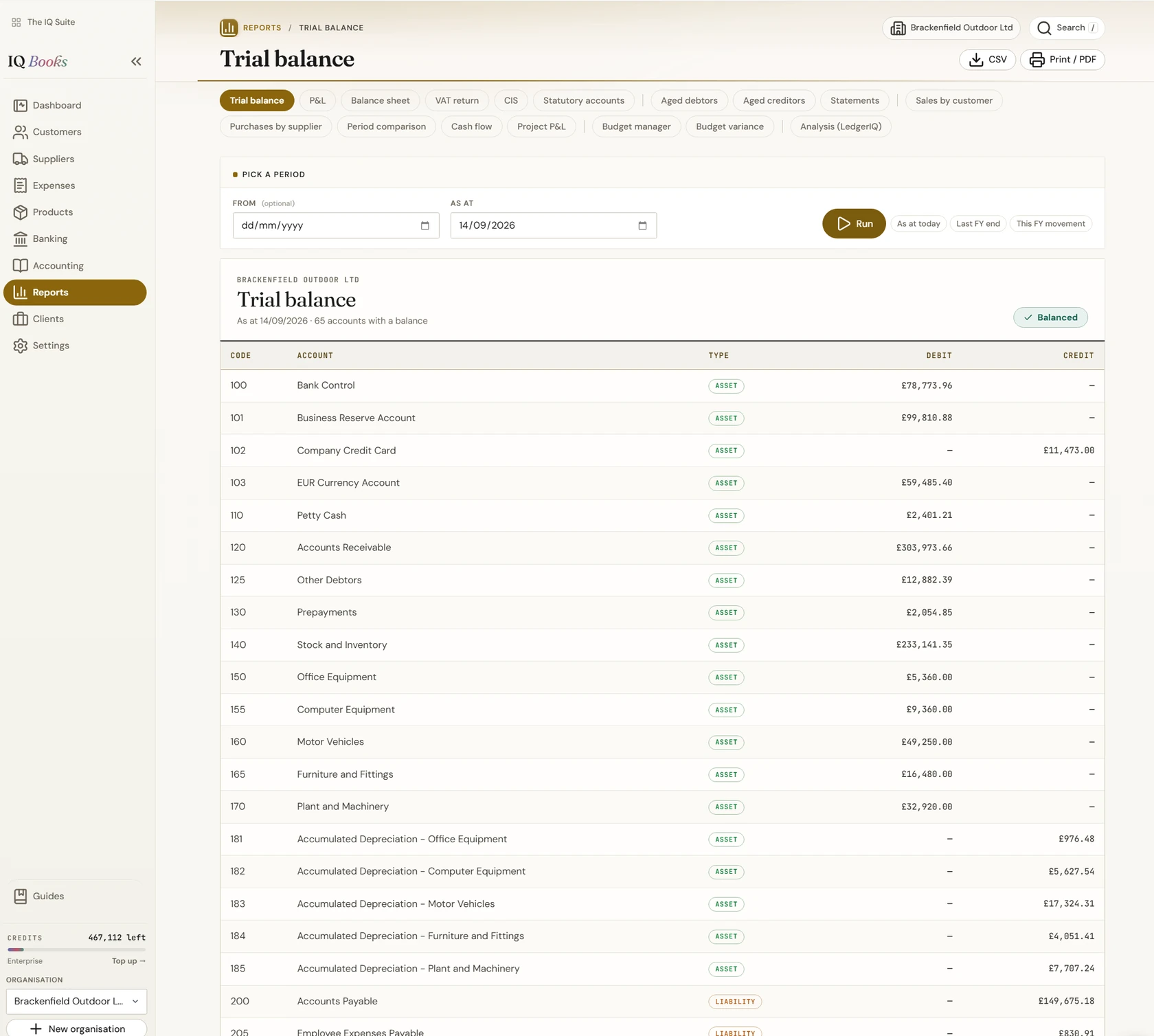
At the year end a limited company’s FRS 105 or FRS 102 Section 1A accounts come from the same books, with the notes, tagged as iXBRL ready for Companies House, so nothing is re-keyed into a separate package. Filing to Companies House is on the paid plans.
- FRS 105 and FRS 102 Section 1A
- Tagged as iXBRL for Companies House
- The balance sheet from the same ledger
03
What the P&L is telling you
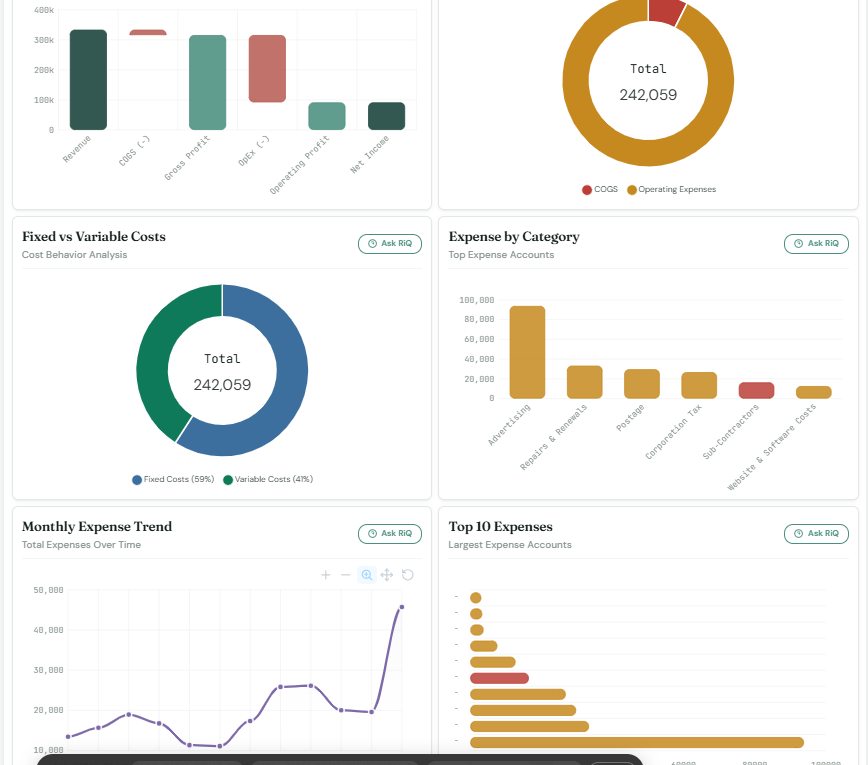
LedgerIQ reads the general ledger behind the profit and loss account and explains it: a waterfall from revenue to net profit, cost of sales against operating expenses, fixed against variable costs, expenses by category and month, with RiQ answering questions about any chart. A full analysis uses 1,000 credits.
- The P&L as a waterfall, revenue to net income
- Costs by category, fixed and variable
- Ask RiQ about any chart
The full ledger, free
IQ Books is free for one organisation with the whole ledger: invoicing and bills, bank lines, VAT and Making Tax Digital filing, and every report, the profit and loss account and balance sheet included. Keying and coding by hand is free; the automation, such as CodeIQ coding the bank, draws on credits, and every account starts with 1,000.
Filing and more, from £5 a month
Paid plans, from £5 a month, add monthly credits for the automation, Companies House filing of the statutory accounts and invoice emailing, and LedgerIQ analysis every month. Practices run it across their clients.
Guide
How to do a profit and loss account in the UK
The profit and loss account format, a worked example, the sole trader version and how to read one. For the balance sheet that goes with it, use the balance sheet template.
What is a profit and loss account?
In accounting, a profit and loss account shows what a business earned and spent over a period, usually its financial year, and the profit or loss that leaves. It is the same report whatever it is called: a profit and loss statement, a P&L, a statement of profit or loss, or in American usage an income statement. UK company law calls it the profit and loss account. It is prepared on the accruals basis, so sales count when they are earned and costs when they are incurred, not when the money arrives or leaves, which is why the profit is rarely the same as the change in the bank balance.
The profit and loss account format
The profit and loss account statement format everyone recognises, and the one in the template, runs from the top line to the bottom line:
Turnover
− cost of sales
= gross profit
+ other operating income
− administrative expenses (and distribution costs)
= operating profit
+ interest receivable − interest payable
= profit before tax
− tax on profit
= profit for the financial year
For a limited company that order comes from the law. The Small Companies Regulations 2008 (SI 2008/409, Schedule 1, Format 1) set the headings: turnover, cost of sales, gross profit or loss, distribution costs, administrative expenses, other operating income, the investment income and interest lines, tax on profit or loss, and the profit or loss for the financial year. A micro-entity can use a shorter format with eight headings: turnover, other income, cost of raw materials and consumables, staff costs, depreciation and other amounts written off assets, other charges, tax, and profit or loss. Inside those headings you can show as much detail as is useful; the template lists each expense line under administrative expenses.
Gov.uk says a small company can choose whether to send its profit and loss account to Companies House, and a micro-entity sends only a simpler balance sheet. Either way the full accounts, profit and loss account included, still go to the members and to HMRC.
A profit and loss account example
Here is a sample profit and loss account, a profit and loss statement example (an income statement example, in American terms) for a small limited company. Harbour Florists Ltd, an illustrative business, has this profit and loss account for its year to 31 March 2026, with the year before alongside. It is the worked example loaded in the template above, so you can change any figure and see the margins move.
| Harbour Florists Ltd, year ended 31 March 2026 | £ | 2025 £ |
|---|---|---|
| Turnover | 229,150 | 207,100 |
| Cost of sales (opening stock 3,200, purchases and delivery 84,820, less closing stock 3,650) | (84,370) | (76,670) |
| Gross profit (gross margin 63.2%) | 144,780 | 130,430 |
| Administrative expenses | (115,760) | (108,650) |
| Operating profit (12.7%) | 29,020 | 21,780 |
| Interest receivable | 85 | 40 |
| Interest payable | (1,240) | (1,310) |
| Profit before tax | 27,865 | 20,510 |
| Tax on profit | (5,182) | (3,925) |
| Profit for the financial year (net margin 9.9%) | 22,683 | 16,585 |
Two things are worth noticing. Cost of sales includes the change in stock: the shop started the year with £3,200 of stock and ended it with £3,650, so the £450 increase comes off the purchases. And the £5,182 of tax is not 19% of the profit before tax: it comes from the corporation tax computation, which adds back the £3,210 of depreciation and deducts the capital allowances instead, then applies the 19% small profits rate. The corporation tax calculator does that last step.
How to do a profit and loss account, step by step
To calculate profit and loss for a period, work down from the top line:
- Pick the period. Usually the financial year; a month or a quarter works the same way for management accounts.
- Total the turnover. All sales, fees and takings for the period, excluding VAT if you are VAT registered.
- Work out the cost of sales. Opening stock, plus purchases and direct costs, less closing stock. If you hold no stock, it is simply the direct costs.
- List the running costs. Wages, directors’ pay, rent and rates, light and heat, insurance, motor, telephone, software, advertising, professional fees, bank charges, repairs and depreciation. Leave out drawings, dividends and loan repayments (only the interest is a cost).
- Subtract down to the bottom line. Gross profit, then operating profit, then for a company interest and tax, to the profit for the year.
- Compare and check. Set it against last year and look at the margins; a cost that has doubled, or a margin that has moved a long way, is usually a posting worth checking.
Most of the work is in steps 2 to 4, and it is the same work a bookkeeping system does as you go. If the figures come from a trial balance, every income and expense account goes on the profit and loss account and every asset, liability and capital account on the balance sheet.
A sole trader profit and loss account
A sole trader’s profit and loss account has the same shape, but the person and the business are one, so there is no corporation tax and no dividends: the net profit is the owner’s taxable income for the year, through Self Assessment. Choose Sole trader in the template and the expenses are grouped the way HMRC’s self-employment pages (SA103S) ask for them, so the totals drop straight into the return:
| SA103S box | Heading |
|---|---|
| 9 | Your turnover: the takings, fees, sales or money earned by your business |
| 11 | Costs of goods bought for resale or goods used |
| 12 | Car, van and travel expenses, after the private use proportion |
| 13 | Wages, salaries and other staff costs |
| 14 | Rent, rates, power and insurance costs |
| 15 | Repairs and maintenance of property and equipment |
| 16 | Accountancy, legal and other professional fees |
| 17 | Interest and bank and credit card financial charges |
| 18 | Phone, fax, stationery and other office costs |
| 19 | Other allowable business expenses (client entertaining is not allowable) |
| 21 | Net profit |
The sole trader example, Ashworth Joinery, turned over £64,800, spent £14,260 on timber and materials and £11,920 on running costs, a net profit of £38,620. HMRC’s short form lets a business with turnover below £90,000 give its total expenses in one box rather than line by line. Your drawings are not an expense, and for tax depreciation is not deductible: you claim capital allowances, or the cost of most equipment under the cash basis, instead. Our self-employed tax calculator turns the net profit into the Income Tax and National Insurance to pay.
How to read a profit and loss account
Three margins tell you most of what the profit and loss account has to say, and the template works them out as you type:
- Gross margin, gross profit as a share of turnover: whether your prices cover what you buy or make. A falling gross margin usually means costs rose faster than prices.
- Operating margin, operating profit as a share of turnover: whether the business covers its overheads.
- Net margin, the profit for the year as a share of turnover: what is left for the owners after everything.
Read them against last year rather than against a rule of thumb; what is healthy depends on the trade. To work out the margin or markup on a single product or price, use the profit margin calculator.
Profit and loss account and balance sheet
The profit and loss account and the balance sheet are the two halves of a set of accounts. The profit and loss account covers the year; the balance sheet is a snapshot of what the business owns and owes on the last day. They meet in one figure: the profit for the year is added to the profit and loss reserve on a company’s balance sheet (less any dividends), or to a sole trader’s capital account (less drawings). Fill this template first, then carry the profit into the balance sheet template.
A profit and loss template in Excel
The free profit and loss account template in Excel for a limited company, and the sole trader version, have this year and last year side by side and the formulas in place:
Cost of sales = opening stock + SUM(purchases and direct costs) − closing stock
Gross profit = turnover − cost of sales
Operating profit = gross profit + other income − SUM(expenses)
Profit for the year = operating profit + interest receivable − interest payable − tax
Margin = profit ÷ turnover
Fill in the shaded cells and every total works itself out: a one-page profit and loss sheet, laid out as a profit and loss statement template you can reuse as a monthly profit and loss report. It is a P&L, or profit and loss statement, template in Excel format, and the files open in Excel, Google Sheets, Numbers and LibreOffice with the formulas intact. If you fill the statement on this page instead, the Excel download carries the same live formulas, so it doubles as next year’s P&L template. For a monthly or year-to-date profit and loss, use one column per month, or run the same template with the period set to the year so far.
Sources: the Small Companies and Groups (Accounts and Directors’ Report) Regulations 2008, Schedule 1, on legislation.gov.uk; gov.uk, accounts for micro-entities and small companies; HMRC, Self-employment (short) SA103S for 2025 to 2026.
Questions
Profit and loss, answered
About the profit and loss account, the template, and what IQ Books does for you.
What is a profit and loss statement?
A profit and loss statement, also called a profit and loss account, a P&L or an income statement, shows how much a business earned and spent over a period, usually a year, and the profit or loss left at the end. It runs from turnover, less the cost of sales to gross profit, less the running costs to operating profit, then interest and tax down to the profit for the year.
Is a profit and loss statement the same as an income statement?
Yes. Profit and loss account, profit and loss statement, P&L and income statement all mean the same report. UK company law and the small company formats call it the profit and loss account; international standards call it the statement of profit or loss; income statement is the American usage.
What should a profit and loss template include?
Turnover; cost of sales, adjusted for opening and closing stock if you hold any; gross profit; the administrative expenses line by line; operating profit; interest received and paid; tax on profit for a company; and the profit or loss for the period. A good template also shows last year alongside and the gross and net margins, which this one does.
How do I do a profit and loss account for a small business?
Total your sales for the period, before VAT if you are VAT registered. Take off the cost of what you sold, adjusting for stock, to get gross profit. List and total the running costs and take them off to get operating profit. For a company, add interest received, take off interest paid and corporation tax to reach the profit for the financial year. Use the accruals basis: income when earned and costs when incurred, not when the cash moves.
How do I do a profit and loss account as a sole trader?
Use the same shape, with the expenses grouped the way HMRC’s self-employment pages ask for them: costs of goods bought for resale, car, van and travel, wages, rent, rates, power and insurance, repairs, professional fees, interest and bank charges, phone and office costs, and other allowable expenses. Turnover less those expenses is your net profit. Choose Sole trader in the template above to lay it out that way.
What is the difference between gross profit and net profit?
Gross profit is turnover less the direct cost of what you sold. Net profit is what is left after every other cost too: wages, rent, insurance, motor, professional fees, depreciation, interest and, for a company, tax. Gross margin tells you about pricing and buying; net margin tells you whether the business as a whole makes money.
What is the difference between a profit and loss account and a balance sheet?
The profit and loss account covers a period and shows the income, costs and profit for it. The balance sheet is a snapshot at one date and shows what the business owns and owes, and the capital. The two connect: the profit for the year adds to the reserves (or a sole trader’s capital) on the balance sheet. Our free balance sheet template follows on from this one.
Can I download a free profit and loss template in Excel?
Yes. Download the blank profit and loss template for a limited company or the sole trader version, both with the formulas built in, or fill the statement on this page and download it as Excel, CSV or PDF. They open in Excel, Google Sheets, Numbers and LibreOffice.
Do small companies have to file a profit and loss account at Companies House?
Not always. Gov.uk says a small company can choose whether to send its profit and loss account and directors’ report to Companies House, and a micro-entity sends only a simpler balance sheet. Every company still prepares full accounts, including the profit and loss account, for its members and for HMRC with the corporation tax return.
Are drawings and dividends included in the profit and loss account?
No. Drawings are a sole trader taking money out of the business, and dividends are a company paying its shareholders from profits; neither is a cost of running the business, so neither goes in the profit and loss account. Drawings reduce the owner’s capital and dividends reduce the company’s reserves, both on the balance sheet.
Is corporation tax in the profit and loss account?
Yes, for a company. Tax on profit is the last line before the profit for the financial year. The figure comes from the corporation tax computation, which starts from the accounting profit and adjusts it, adding back depreciation and claiming capital allowances, for example. To estimate it, use our free corporation tax calculator.
Can software produce my profit and loss account for me?
Yes. IQ Books by ReconcileIQ produces the profit and loss account live from the books you keep in it, for any period and against last year, with every figure linked to its transactions, and it is free for one organisation. At the year end a limited company’s statutory accounts come from the same ledger.
Stop building the P&L by hand.
IQ Books keeps the books and produces the profit and loss account and balance sheet live, with VAT and MTD filed from the same ledger. Free for one organisation.