Self-employed tax calculator
Work out the Income Tax and Class 4 National Insurance on your self-employed profit, in England, Wales, Northern Ireland or Scotland, including a salary if you are employed as well. See what to set aside each month, and whether Making Tax Digital applies to you.
It runs in your browser: nothing you type is sent anywhere or saved.
2026 to 2027 · England, Wales or Northern Ireland
to set aside for tax and National Insurance on your self-employment.
Income Tax by band
Keep the books in IQ Books and send your MTD quarterly updates free.
Try IQ Books freeRates used for 2026 to 2027, checked against gov.uk on 5 October 2026
Sources:
This is an estimate to help you plan, not tax advice. It covers Income Tax on self-employed profit and any salary, and Class 4 National Insurance. It does not include student loan or postgraduate loan repayments, pension contributions, Marriage Allowance, Gift Aid, Blind Person's Allowance, savings interest or dividends, losses carried from other years, or tax on rental profit. It assumes your salary is taxed correctly through PAYE and that your Personal Allowance is only reduced by income above £100,000.
IQ Books by ReconcileIQ
Keep the books, and the tax takes care of itself
This calculator estimates the bill. IQ Books keeps the records behind it, from bank lines and receipts to invoices, and sends your Making Tax Digital quarterly updates to HMRC, nearly all of it on the free plan.
01
Quarterly updates, sent free
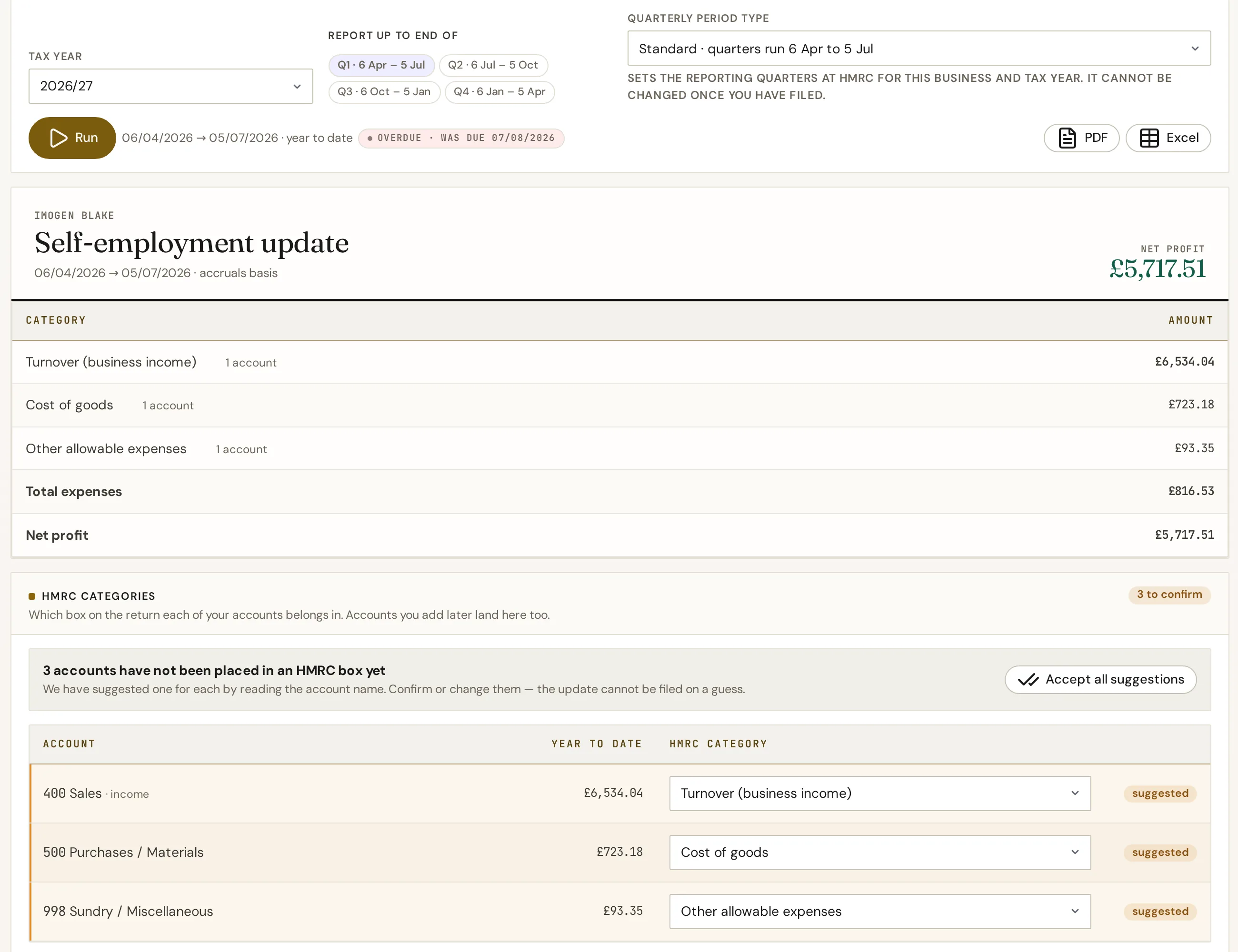
IQ Books is on HMRC’s list of software for Making Tax Digital for Income Tax. It totals each quarter straight from your books, places every account in HMRC’s categories with suggestions you confirm, shows the net profit, and sends the update.
- Self-employment quarterly updates on every plan, the free one included
- Accounts mapped to HMRC’s categories, so the update matches the books
- The year-end final declaration is not filed from IQ Books yet: under Making Tax Digital it goes through MTD software that supports it, or your accountant
- Self-employment only for now: landlord filing is not live yet
02
Bank lines, coded on arrival
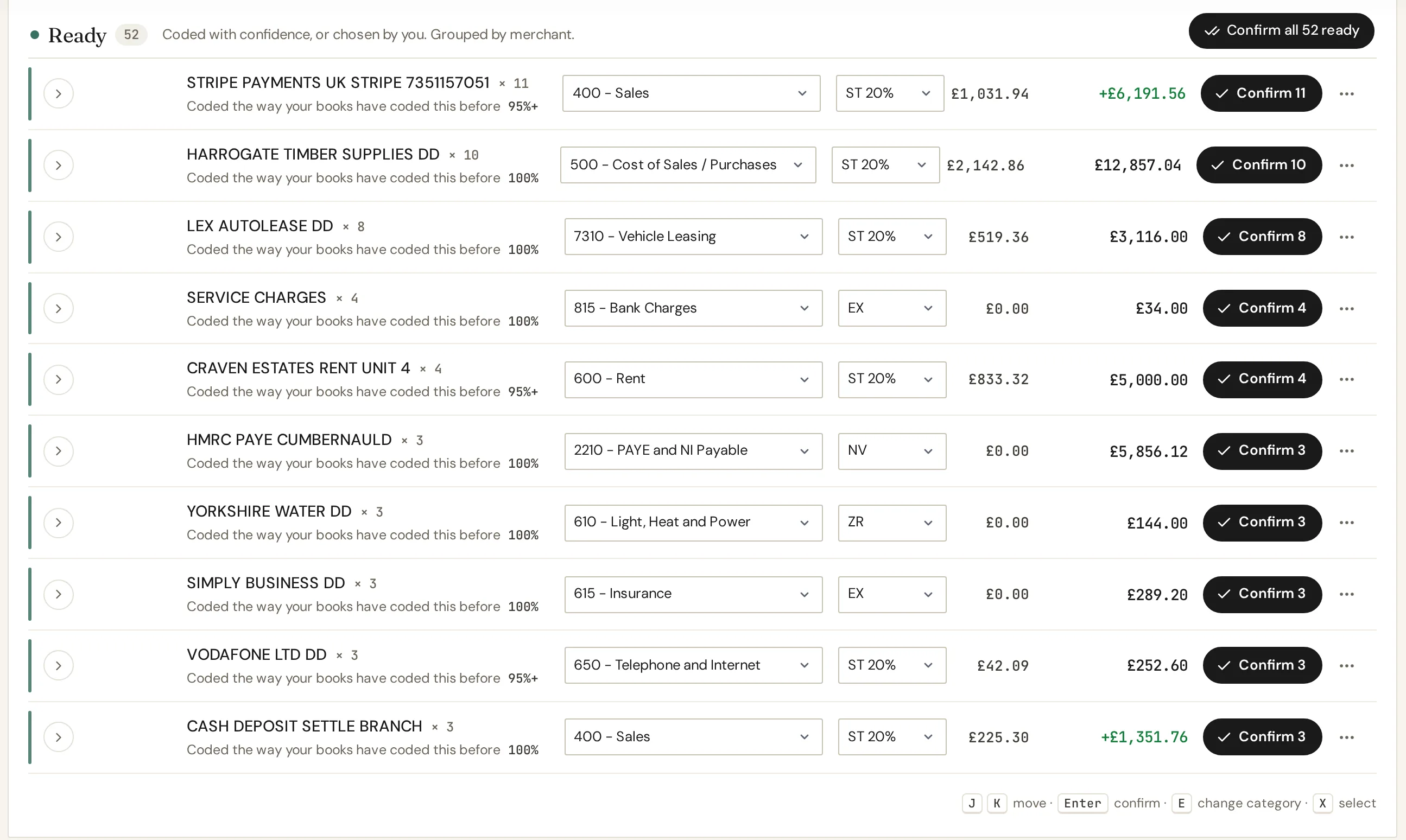
Connect your bank by open banking and new transactions arrive in IQ Books already coded by CodeIQ, the bookkeeping engine built in: the account, the VAT and the merchant, grouped so you confirm a whole batch in one click.
- Open banking feeds, or import a statement file
- Coded the way your books have coded that merchant before, with the confidence shown
- Coding by hand is always free; CodeIQ coding uses credits, with 1,000 free to start
03
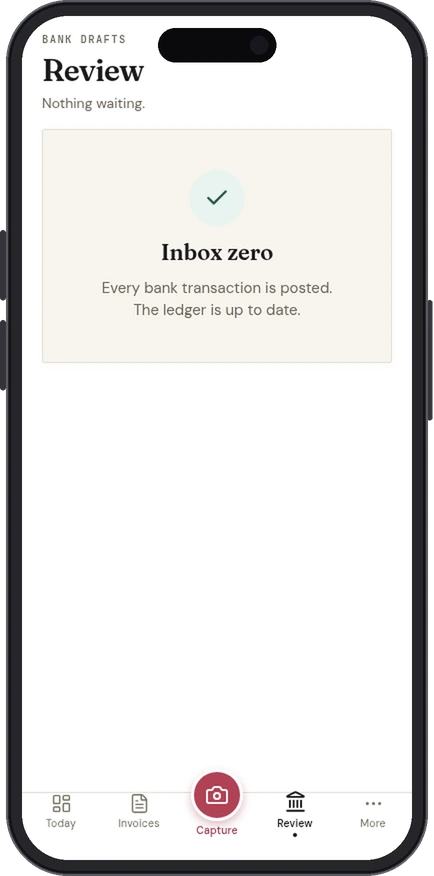
Receipts in, from your pocket
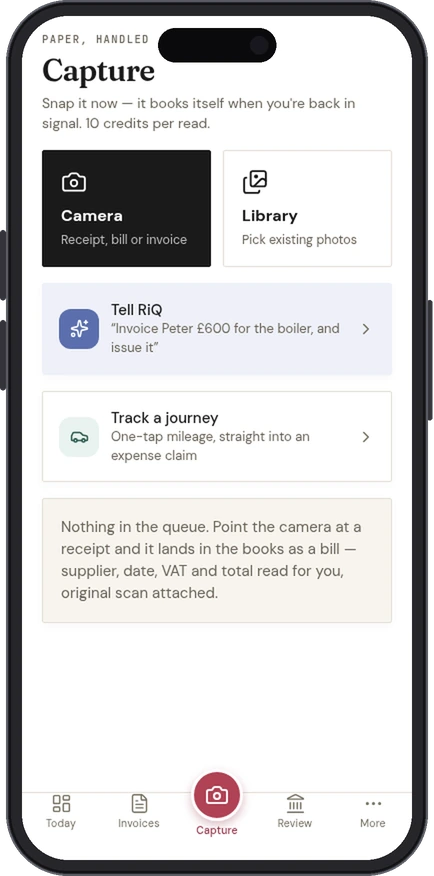
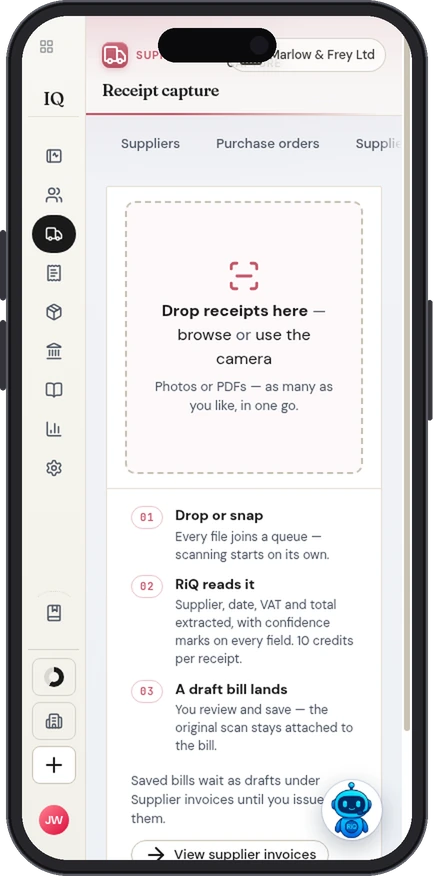
Snap a receipt and it lands in the books as a bill: supplier, date, VAT and total read for you, with the original scan attached. Business journeys go straight into an expense claim, and the bank review works on the move. IQ Books already works in your phone’s browser, and the IQ Books app is coming soon to the App Store and Google Play.
- Receipts read for you, with a confidence mark on every field (10 credits a receipt)
- One-tap mileage, straight into an expense claim
- Review and confirm bank lines wherever you are
04
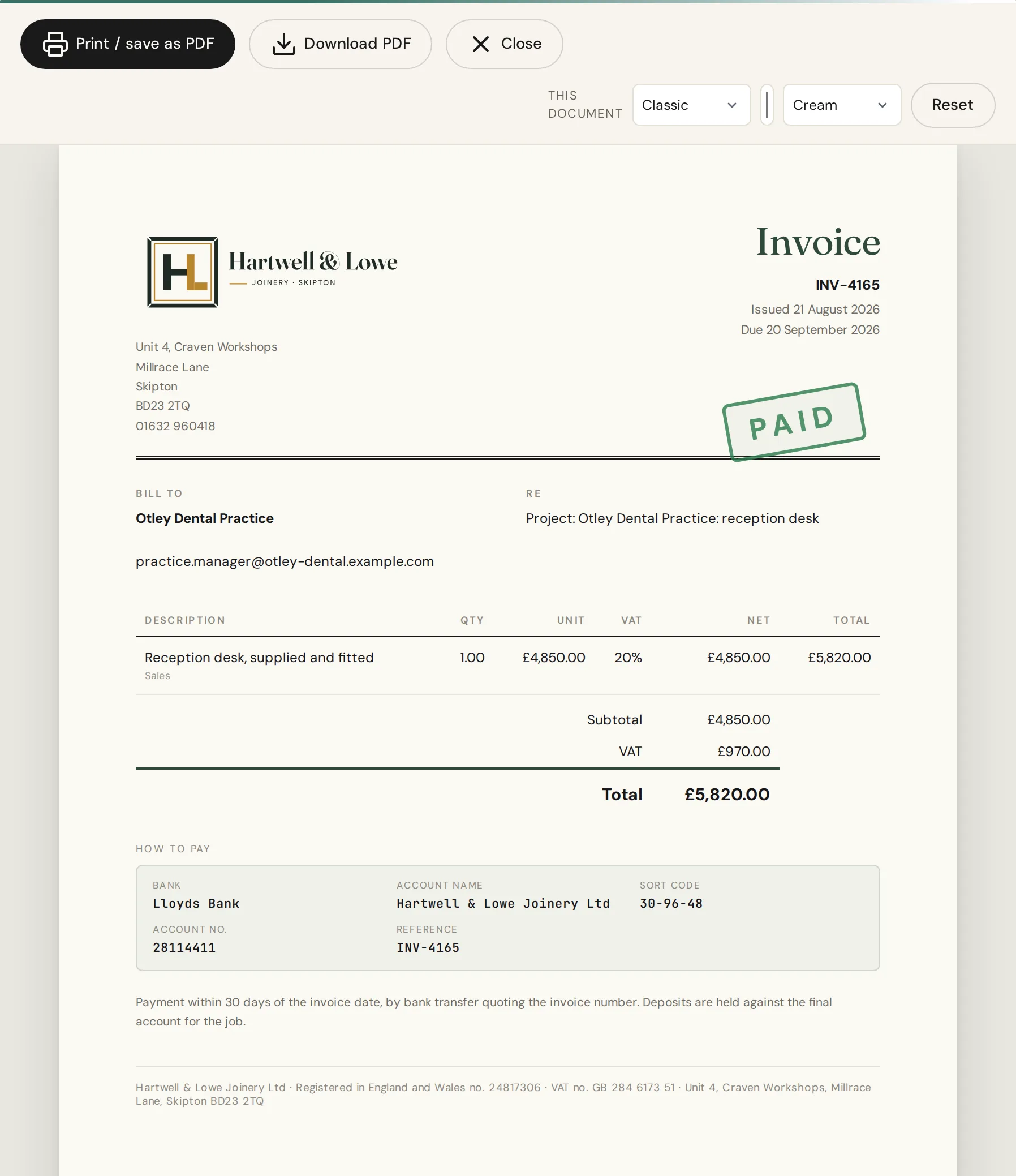
Invoices that count themselves
Raise invoices in seven designs, share them by pay link and take card payments through your own Stripe account. When a customer pays, the payment lands against the invoice and your income for the quarter is already in the books, with nothing to retype.
- Seven invoice designs, with a scan-to-pay QR code
- Payments matched to the invoice and the bank line
- Try the designs now with the free invoice template
Everything above, free
One organisation with the whole IQ Books ledger: bank accounts with open banking feeds, receipts, invoices and quotes, customers and suppliers, VAT returns and Making Tax Digital for Income Tax quarterly updates. Typing and coding by hand is always free; automation such as reading receipts and coding bank lines draws on 1,000 free credits.
More credits, more automation
Paid plans, from £5 a month, add monthly credits so the bookkeeping keeps doing itself, emailing invoices and automatic payment reminders from the app, and CIS300 filing for contractors.
Guide
Self-employed tax, worked out
Three numbers decide your bill: your profit, where you live, and whether you have a salary as well. Here is what the calculator is doing with them.
Profit first, then Income Tax
You are taxed on profit: your income for the tax year minus allowable expenses (or minus the £1,000 trading allowance, if that is more useful to you). Profit is added to any other income, the Personal Allowance of £12,570 comes off the top, and the rest is taxed in bands. In England, Wales and Northern Ireland that is 20% up to £50,270, 40% up to £125,140 and 45% above. Scotland sets its own bands, from a 19% starter rate to a 48% top rate. Above £100,000 the Personal Allowance shrinks by £1 for every £2, so it is gone entirely at £125,140.
If you also have a job, your salary uses up the Personal Allowance and the lower bands first, through PAYE. The calculator works out tax on everything together, takes away the tax on the salary alone, and shows the difference as the tax on your self-employment.
Class 4 and Class 2 National Insurance
Class 4 National Insurance is charged on profit alone, not salary: 6% on profit between £12,570 and £50,270, and 2% on anything above, in both of the years covered here. It is collected with your Income Tax through Self Assessment.
Class 2 is no longer something most people pay. If your profit is at or above the small profits threshold (£7,105 in 2026 to 2027, £6,845 in 2025 to 2026) you are treated as having paid it, which protects your State Pension record. Below that you can choose to pay voluntary Class 2, at £3.65 a week for 2026 to 2027.
Payments on account
Once your Self Assessment bill passes £1,000, HMRC usually asks for next year's tax in advance: two payments on account, each half of this year's bill, due on 31 January and 31 July. They do not apply if more than 80% of your tax was already taken at source, for example through PAYE. In the first year it applies, 31 January can bring the balance of one year and the first payment on account for the next, which is the bill that surprises people. Setting aside the monthly figure above from day one is the simplest defence.
Key dates
| Date | What happens |
|---|---|
| 5 October | Register for Self Assessment if you started trading in the tax year that ended on 5 April. |
| 31 January | Online tax return due, with the balance of the year's tax and the first payment on account for the next. |
| 31 July | Second payment on account due. |
| 7 Aug, 7 Nov, 7 Feb, 7 May | Making Tax Digital for Income Tax quarterly update deadlines, once you are in it. |
Making Tax Digital for Income Tax
Sole traders and landlords whose qualifying income is over the threshold now keep digital records and send HMRC a quarterly update from compatible software. Qualifying income is turnover plus gross rental income, before expenses, not profit. Over £50,000 in 2024 to 2025 meant joining from 6 April 2026; over £30,000 in 2025 to 2026 means joining from 6 April 2027; and over £20,000 in 2026 to 2027 means joining from 6 April 2028. The year-end tax return, the final declaration, is then submitted from MTD software too. There is a plain-English walk-through in Making Tax Digital for sole traders who have never kept books, how IQ Books handles it on our MTD software page, and a comparison of the software in the best accounting and MTD software for sole traders.
Rates and rules checked against gov.uk on 5 October 2026: HMRC: Income Tax rates and allowances; GOV.UK: Income Tax in Scotland; GOV.UK: Self-employed National Insurance rates; GOV.UK: Payments on account; GOV.UK: When you need to use Making Tax Digital for Income Tax.
Questions
Frequently asked
About self-employed tax, and what IQ Books does with it.
How much tax do you pay when you are self-employed in the UK?
You pay Income Tax and Class 4 National Insurance on your profit, which is your income minus allowable expenses. In 2026 to 2027 the first £12,570 is covered by the Personal Allowance, then Income Tax is 20% up to £50,270, 40% up to £125,140 and 45% above that (Scotland has its own bands). Class 4 National Insurance is 6% on profits between £12,570 and £50,270 and 2% above. On a £30,000 profit in England that comes to about £4,532 for the year.
How much should I set aside for tax when I am self-employed?
Work out your expected profit and use the calculator to see the Income Tax and National Insurance on it, then divide by twelve and move that amount into a separate account each month. As a rough guide a basic-rate sole trader in England sets aside around 15% of profit, rising towards a quarter or more as profit moves into the higher rate. Payments on account can bring part of next year's bill forward, so keep a margin.
Do self-employed people pay National Insurance?
Yes, Class 4 National Insurance on profits above £12,570: 6% up to £50,270 and 2% on anything above, in both 2025 to 2026 and 2026 to 2027. Class 2 is no longer compulsory. If your profit is at least the small profits threshold (£7,105 in 2026 to 2027) you get Class 2 credits without paying, and below it you can choose to pay voluntary Class 2 at £3.65 a week to protect your State Pension record.
What is the £1,000 trading allowance?
It is a tax-free allowance of up to £1,000 a year for trading income. If your gross trading income is £1,000 or less you may not need to tell HMRC. If it is more, you can deduct the £1,000 allowance instead of your actual expenses, which helps when your expenses are lower than £1,000. You cannot use both, and it does not apply to partnership income.
What are payments on account?
They are advance payments towards next year's tax bill, each half of the previous year's Self Assessment bill (Income Tax and Class 4 National Insurance), due by 31 January and 31 July. You do not have to make them if last year's bill was under £1,000, or if more than 80% of your tax was already paid at source, for example through PAYE on a salary.
Do I need to use Making Tax Digital for Income Tax?
If you are a sole trader or landlord and your qualifying income (turnover plus gross property income, before expenses) is over the threshold, yes. Over £50,000 in 2024 to 2025 meant joining from 6 April 2026, over £30,000 in 2025 to 2026 means joining from 6 April 2027, and over £20,000 in 2026 to 2027 means joining from 6 April 2028. You then keep digital records and send quarterly updates from compatible software.
Does the calculator work if I live in Scotland?
Yes. Choose Scotland and it applies the Scottish Income Tax bands for the year you pick, from the 19% starter rate to the 48% top rate. Class 4 National Insurance is the same across the UK, so that part does not change.
Can IQ Books send my MTD quarterly updates?
Yes. IQ Books is on HMRC's list of software for Making Tax Digital for Income Tax and sends self-employment quarterly updates on every plan, the free one included. It works the figures out from your books and maps each account to HMRC's categories. The year-end final declaration is not filed from IQ Books yet: under Making Tax Digital it is submitted with MTD software that supports it, or by your accountant.
Is IQ Books free for sole traders?
Yes. The free plan is one organisation with the whole ledger: invoices, bank accounts with open banking feeds, receipts, VAT returns and Making Tax Digital for Income Tax quarterly updates. Typing and coding by hand is always free; automation such as reading receipts and coding bank lines uses credits, with 1,000 free to start. Paid plans from £5 a month add monthly credits, emailing invoices and automatic reminders from the app, and CIS300 filing.
Keep the books. Send the quarters. Free.
IQ Books keeps your self-employed records, from invoices and receipts to bank lines coded for you, and sends your Making Tax Digital for Income Tax quarterly updates to HMRC on the free plan. The final declaration goes through other MTD software, or your accountant, for now.