Free balance sheet template for UK businesses
A free, simple balance sheet template for a small business, in the UK balance sheet format. Fill it in here: fixed assets, current assets, creditors due within a year, net current assets, longer-term creditors and net assets, against the capital and reserves or, for a sole trader, the capital account. The template checks it balances as you type and tells you where to look when it does not. Keep last year alongside, then download it as Excel with live formulas, a CSV or a PDF.
Everything runs in your browser. Nothing you type is sent to us or saved.
Balance Sheet Template
Fill in the assets and liabilities, then the capital. The two halves must agree.
A balance sheet that always balances. IQ Books produces it live from a double-entry ledger, on any date, free for one organisation.
Try IQ Books freeThis free balance sheet template lays out and adds up the figures you enter, and checks the two halves agree. It is not a set of statutory accounts: a company’s accounts follow the Companies Act formats and accounting standards, with notes. The figures are only as good as the ones you type in.
IQ Books by ReconcileIQ
The same balance sheet, from the books themselves
This template is the balance sheet on paper. IQ Books produces it from a double-entry ledger, so it balances by construction: every invoice, bill and bank line you post moves the right accounts, and the balance sheet is current on any date you pick.
01
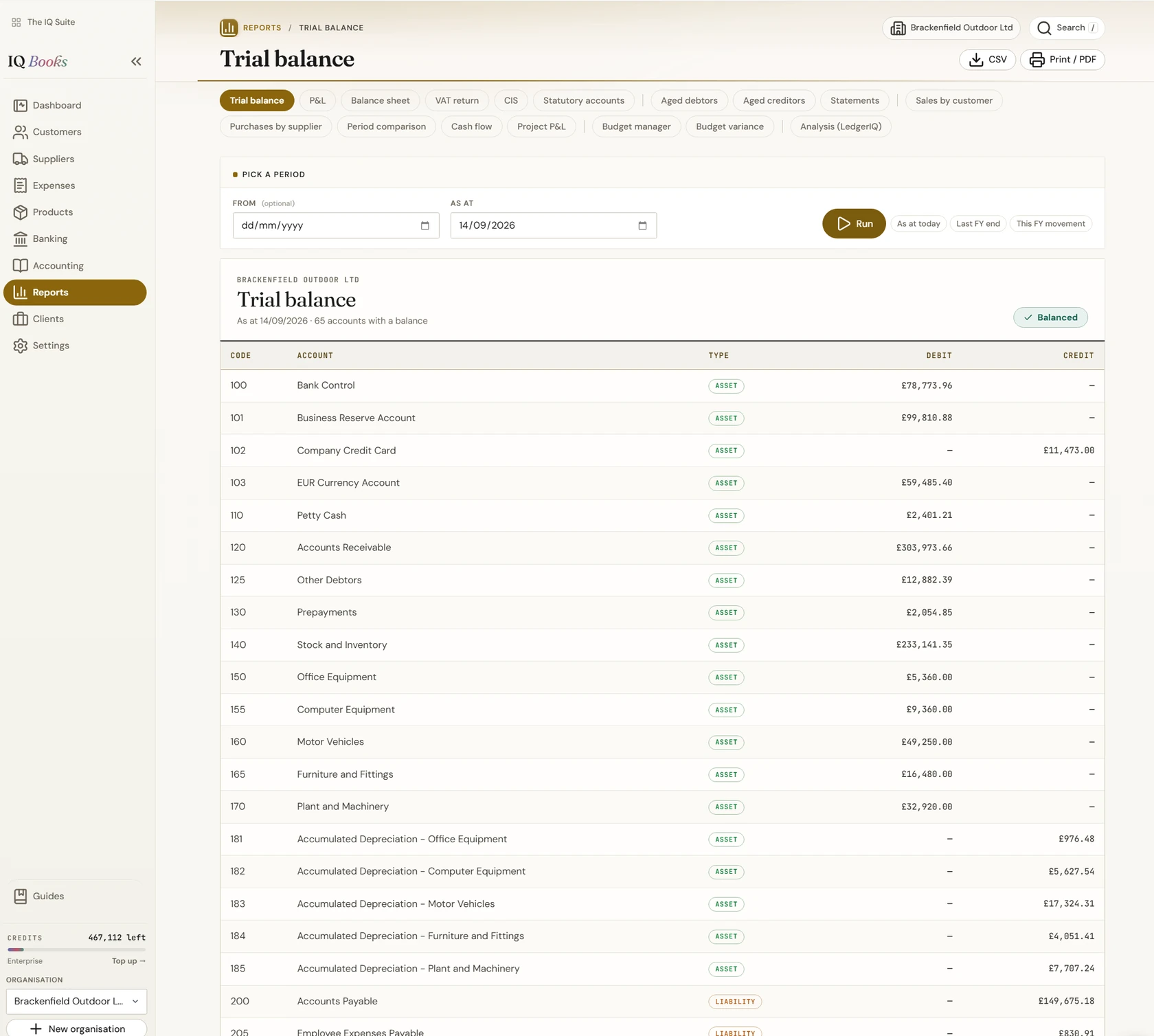
A live balance sheet, on any date
Run the balance sheet as at any date, beside the trial balance it comes from, the profit and loss account, the aged debtors and creditors and the cash flow. Every value drills down to its transactions, and the reports export to CSV or print.
- Any date you pick
- The trial balance it comes from, always balanced
- Aged debtors and creditors behind the figures
02
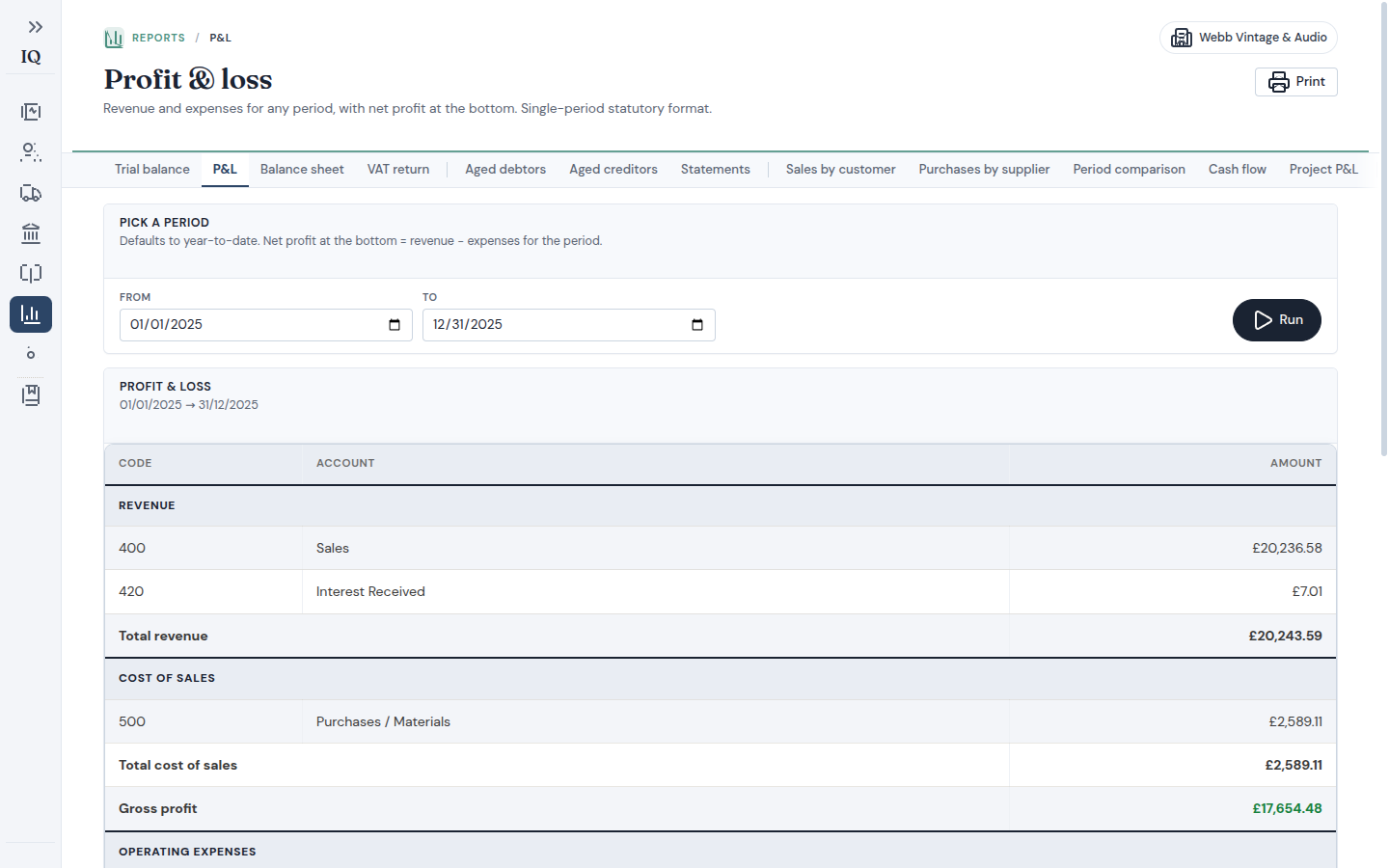
Statutory accounts from the same ledger
At the year end a limited company’s FRS 105 or FRS 102 Section 1A accounts come from the same books, with the notes, tagged as iXBRL ready for Companies House, so the balance sheet is never re-keyed into a separate package. Filing to Companies House is on the paid plans.
- FRS 105 and FRS 102 Section 1A
- Tagged as iXBRL for Companies House
- Fixed asset register with depreciation posted for you
03
What the balance sheet is telling you
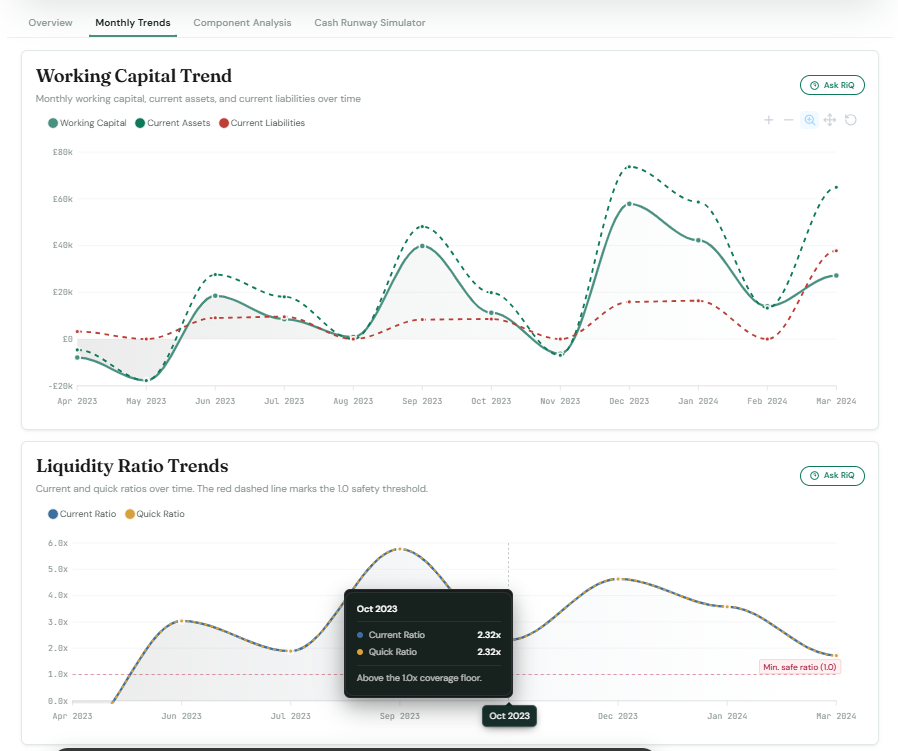
LedgerIQ reads the general ledger behind the balance sheet and tracks it month by month: current assets against current liabilities, the current and quick ratios against a 1.0 safety line, working capital, debt and leverage, and a financial health score, with RiQ explaining any of it. A full analysis uses 1,000 credits.
- Working capital and liquidity, month by month
- Current and quick ratio trends
- Debt, leverage and a health score
The full ledger, free
IQ Books is free for one organisation with the whole ledger: invoicing and bills, bank lines, VAT and Making Tax Digital filing, and every report, the profit and loss account and balance sheet included. Keying and coding by hand is free; the automation, such as CodeIQ coding the bank, draws on credits, and every account starts with 1,000.
Filing and more, from £5 a month
Paid plans, from £5 a month, add monthly credits for the automation, Companies House filing of the statutory accounts and invoice emailing, and LedgerIQ analysis every month. Practices run it across their clients.
Guide
How to do a balance sheet in the UK
The UK balance sheet format, a worked example, the sole trader version and why one might not balance. For the profit and loss account that comes first, use the profit and loss template.
What is a balance sheet?
A balance sheet is a snapshot of a business on a single date, usually the last day of its financial year. It lists what the business owns, its assets, and what it owes, its liabilities. What is left over, the net assets, belongs to the owners, and the bottom half of the balance sheet shows how: for a company, the share capital and the profits kept in the business (the reserves); for a sole trader, the capital account. Because the bottom half is just another way of measuring the same figure, the two halves always agree.
The UK balance sheet format
UK small businesses almost always use the vertical layout, and so does the template:
Fixed assets
+ current assets
− creditors: amounts falling due within one year
= net current assets (liabilities)
= total assets less current liabilities
− creditors: amounts falling due after more than one year
− provisions for liabilities
= net assets
Capital and reserves = net assets
For a limited company those headings are set by the Small Companies Regulations 2008 (SI 2008/409, Schedule 1, Format 1): called up share capital not paid, fixed assets (intangible assets, tangible assets, investments), current assets (stocks, debtors, investments, cash at bank and in hand), prepayments and accrued income, creditors due within one year, net current assets (liabilities), total assets less current liabilities, creditors due after more than one year, provisions for liabilities, accruals and deferred income, and capital and reserves (called up share capital, share premium, revaluation reserve, other reserves and the profit and loss account). Prepayments can be shown within debtors, which is what most small companies do. A micro-entity uses the same main headings with fewer of the subheadings, under FRS 105, so a micro-entity balance sheet example shows single totals for fixed assets, current assets and each creditor heading; a small company reporting under FRS 102 Section 1A uses the full Format 1 balance sheet format.
Gov.uk says a micro-entity sends only its balance sheet, with less information, to Companies House. A company is a micro-entity if it meets two of: turnover of £1 million or less, a balance sheet total of £500,000 or less, and 10 employees or fewer; small companies have higher limits of £15 million, £7.5 million and 50 employees.
A balance sheet example
Here is a basic balance sheet example, a simple UK balance sheet example for a small business. Harbour Florists Ltd, an illustrative company, has this balance sheet at 31 March 2026, with the year before alongside. It is the worked example loaded in the template above, and it follows on from the same company’s profit and loss account.
| Harbour Florists Ltd, at 31 March 2026 | £ | 2025 £ |
|---|---|---|
| Fixed assets: fixtures, vehicles and computer equipment | 27,030 | 28,200 |
| Current assets: stock 3,650, debtors 9,960, cash 28,320 | 41,930 | 38,330 |
| Creditors: amounts falling due within one year | (25,402) | (22,855) |
| Net current assets | 16,528 | 15,475 |
| Total assets less current liabilities | 43,558 | 43,675 |
| Creditors: amounts falling due after more than one year | (14,400) | (19,200) |
| Net assets | 29,158 | 24,475 |
| Called up share capital | 100 | 100 |
| Profit and loss account | 29,058 | 24,375 |
| Total capital and reserves | 29,158 | 24,475 |
The profit and loss reserve is where the two statements meet. It started the year at £24,375, the company made a profit after tax of £22,683, and it paid £18,000 of dividends, so it ends at £29,058. The corporation tax charge from the profit and loss account, £5,182, sits in creditors because it is not due until nine months and a day after the year end, and the bank loan is split between the £4,800 repayable this year and the £14,400 after that.
How to do a balance sheet, step by step
- Start from the trial balance at the balance sheet date, after the year-end adjustments: depreciation, accruals, prepayments and the stock count.
- Fixed assets. Equipment, vehicles, fixtures, property and intangibles, each at cost less accumulated depreciation (net book value).
- Current assets. Closing stock, trade debtors, prepayments and other debtors, and cash at bank and in hand. An overdrawn bank account is a creditor, not negative cash.
- Creditors. Split them: within one year (suppliers, accruals, VAT, PAYE and National Insurance, corporation tax, the overdraft, this year’s loan repayments) and after more than one year (the rest of any loans and finance).
- Work down to net assets. Net current assets, then total assets less current liabilities, then less the long-term creditors and provisions.
- Capital and reserves. Share capital, plus the profit and loss reserve brought forward, plus the year’s profit after tax, less dividends. For a sole trader, the capital account. Check it equals net assets.
A sole trader balance sheet
A sole trader’s balance sheet has the same top half. The bottom half is the capital account: what the owner has in the business. It starts with the capital at the beginning of the year, adds any capital introduced and the net profit from the profit and loss account, and takes off drawings:
Capital at the start of the year
+ capital introduced
+ net profit for the year
− drawings
= capital at the end of the year = net assets
In the sole trader example, Ashworth Joinery started the year with capital of £15,560, made a net profit of £38,620 and drew £34,400, leaving capital of £19,780, which is exactly its net assets: a van, tools, a little stock, debtors and cash, less what it owes suppliers and on the van finance. Choose Sole trader in the template to lay it out this way.
Why a balance sheet doesn’t balance
- The year’s profit is missing from the reserves or the capital account, or the profit from the wrong year is used. The difference equals the profit.
- Dividends or drawings are left out. The difference equals them.
- An item is in the wrong section, an overdraft entered as cash, a debtor as a creditor, or the director’s loan account on the wrong side. That doubles its effect, so the difference is exactly twice the item.
- A transposition. Two digits swapped makes a difference that divides exactly by nine.
- A balance missed or counted twice, often a savings account, the VAT or PAYE control account, or a loan not split between the two creditor headings.
When the difference is not zero, the template above runs these tests on your figures and tells you which item to look at first.
Reading a balance sheet
A few figures do most of the work. Net current assets show whether the short-term assets cover the short-term debts; the current ratio and quick ratio put that as a ratio, and the gearing ratio compares borrowing with the capital. Our gearing ratio calculator works all of them out from the balance sheet, and the debtor days calculator turns the debtors and creditors into the days customers take to pay and the days you take to pay suppliers.
Balance sheet vs profit and loss account
The difference between a balance sheet and a profit and loss account is time. The balance sheet shows the position on the last day; the profit and loss account (or profit and loss statement) shows how the year got there. A healthy profit with a shrinking cash balance usually means the money is tied up in stock or debtors, which only the balance sheet shows. Fill in the profit and loss template first, then carry the profit into this one.
A balance sheet template in Excel
The free balance sheet template for Excel, the balance sheet format in Excel for a limited company, and the sole trader version, have this year and last year side by side with the formulas in place:
Net current assets = SUM(current assets) − SUM(creditors due within one year)
Total assets less current liabilities = SUM(fixed assets) + net current assets
Net assets = total assets less current liabilities − SUM(creditors after one year) − provisions
Difference = net assets − capital and reserves (should be 0.00)
Fill in the shaded cells and the totals and the balance check work themselves out; filled with the worked example above, it doubles as an Excel balance sheet example to learn from. The files open in Excel, Google Sheets, Numbers and LibreOffice. If you fill the balance sheet on this page instead, the Excel download carries the same live formulas, so it works as next year’s template too.
Sources: the Small Companies and Groups (Accounts and Directors’ Report) Regulations 2008, Schedule 1, Part 1, Sections B and C, on legislation.gov.uk; gov.uk, accounts for micro-entities and small companies.
Questions
Balance sheets, answered
About the balance sheet, the UK format, the template, and what IQ Books does for you.
What is a balance sheet?
A balance sheet is a snapshot of a business on one date: what it owns (its assets), what it owes (its liabilities), and the difference, which belongs to the owners as capital. For a company that is the capital and reserves; for a sole trader the capital account. The two sides always agree, which is why it is called a balance sheet.
What is the UK balance sheet format?
Most UK small businesses use the vertical format: fixed assets, then current assets less creditors due within one year to give net current assets, then total assets less current liabilities, less creditors due after more than one year and provisions, to give net assets. Below that, the capital and reserves add up to the same figure. For a company the headings come from the Small Companies Regulations 2008, Schedule 1, Format 1.
What should a balance sheet template include?
Fixed assets at net book value; current assets (stock, debtors, prepayments, cash); creditors due within one year; net current assets; total assets less current liabilities; creditors due after more than one year; provisions; net assets; and the capital and reserves or capital account, with a check that the two halves agree. This template has all of those, and last year alongside.
How do I do a balance sheet for a small business?
Start from the trial balance at the year end. Put every asset account under fixed or current assets, every liability under creditors due within or after one year, and the share capital and profit and loss reserve (or the owner’s capital) at the bottom. Total each section, work down to net assets, and check that net assets equal the capital and reserves. If they do not, the template above suggests where to look.
What does a sole trader’s balance sheet look like?
The top half is the same: fixed assets, current assets, creditors and net assets. The bottom half is the capital account: capital at the start of the year, plus any capital introduced and the net profit for the year, less drawings, equals capital at the end, which should equal the net assets. Choose Sole trader in the template above to lay it out that way.
Why doesn’t my balance sheet balance?
The usual causes: the profit for the year not added to the reserves or capital; dividends or drawings left out; an item in the wrong section, such as an overdraft entered as cash, which doubles its effect; a balance from the trial balance missed or counted twice; or two digits swapped, which makes the difference divisible by nine. The template runs these checks when the difference is not zero.
What are net current assets?
Net current assets are current assets less creditors due within one year: what the business could turn into cash within a year, less what it must pay within a year. A positive figure means the short-term assets cover the short-term debts; a negative one, net current liabilities, is worth a closer look at cash flow. Our gearing ratio calculator works out the current and quick ratios from the same figures.
What is the difference between a balance sheet and a profit and loss account?
The profit and loss account covers a period and shows the income, costs and profit for it; the balance sheet shows the position on the last day of the period. The profit for the year joins them: it adds to the reserves or capital on the balance sheet. Our free profit and loss template comes first.
Where does the director’s loan account go on the balance sheet?
It depends which way it runs. If the company owes the director money, the loan account is a creditor, usually due within one year. If the director owes the company, it is a debtor under current assets, and an overdrawn loan account can have tax consequences for the company and the director worth checking with your accountant.
Do micro-entities file a balance sheet at Companies House?
Yes, only the balance sheet. Gov.uk says a micro-entity can prepare simpler accounts and send only its balance sheet, with less information, to Companies House; a small company can choose whether to send its profit and loss account. A micro-entity meets two of: turnover of £1 million or less, a balance sheet total of £500,000 or less, and 10 employees or fewer.
Can I download a free balance sheet template in Excel?
Yes. Download the blank balance sheet template for a limited company or the sole trader version, both with the formulas and the balance check built in, or fill the balance sheet on this page and download it as Excel, CSV or PDF. They open in Excel, Google Sheets, Numbers and LibreOffice.
Can software produce my balance sheet for me?
Yes. IQ Books by ReconcileIQ produces the balance sheet live from the books you keep in it, on any date, and it always balances because it comes from a double-entry ledger. It is free for one organisation, and at the year end a limited company’s statutory accounts come from the same ledger.
A balance sheet that balances itself.
IQ Books keeps the books in double entry and produces the balance sheet and profit and loss account live, with the statutory accounts from the same ledger. Free for one organisation.