Gearing ratio calculator and the liquidity ratios
Enter a few lines from the balance sheet and the profit and loss account. You get the gearing ratio on both of the definitions accountants use, debt to equity and net gearing, the current ratio, the quick (acid test) ratio and interest cover, each with its formula, the workings, and what the figure is generally taken to mean, with the source for each guide figure. It works as a current ratio calculator and a quick ratio calculator too.
Every sum runs in your browser. Nothing you type is sent to us or saved.
Gearing ratio · long-term borrowing ÷ capital employed
of the long-term capital is borrowed, between the traditional low and high bands.
From the ledger, every month: LedgerIQ works these ratios out from the general ledger with the trend, and IQ Books keeps the balance sheet behind them current.
See LedgerIQ Try IQ Books free| Ratio | Formula | What it tells you |
|---|---|---|
| Gearing ratio | long-term borrowing ÷ (equity + long-term borrowing) × 100 | How much of the long-term capital is borrowed. The definition used in most UK textbooks. |
| Gearing on all borrowing | total borrowing ÷ (total borrowing + equity) × 100 | The same question with the overdraft and short-term loans included. |
| Debt to equity | total borrowing ÷ equity | Pounds borrowed for each pound the owners have in the business. |
| Net gearing | (total borrowing − cash) ÷ equity × 100 | Borrowing after the cash that could repay some of it. |
| Current ratio | current assets ÷ current liabilities | Whether the debts due within a year are covered by the assets that turn into cash within a year. |
| Quick ratio (acid test) | (current assets − stock) ÷ current liabilities | The same, without counting on selling stock. |
| Interest cover | operating profit ÷ interest payable | How many times the year’s profit covers the interest on the borrowing. |
This calculator works from the figures you enter and is a guide to the arithmetic, not advice or a credit assessment. Ratios from one balance sheet are a snapshot: read them with the trend, the business’s sector, and the terms of any loan, which may set its own definitions and limits (covenants).
LedgerIQ and IQ Books by ReconcileIQ
The same ratios, every month, from the ledger
This calculator works from one balance sheet. LedgerIQ reads the whole general ledger, from IQ Books or an export from Xero, QuickBooks, Sage or any other platform, and works out the liquidity, debt and leverage ratios for every month, so you see which way they are moving. IQ Books keeps the balance sheet behind them current every day.
01
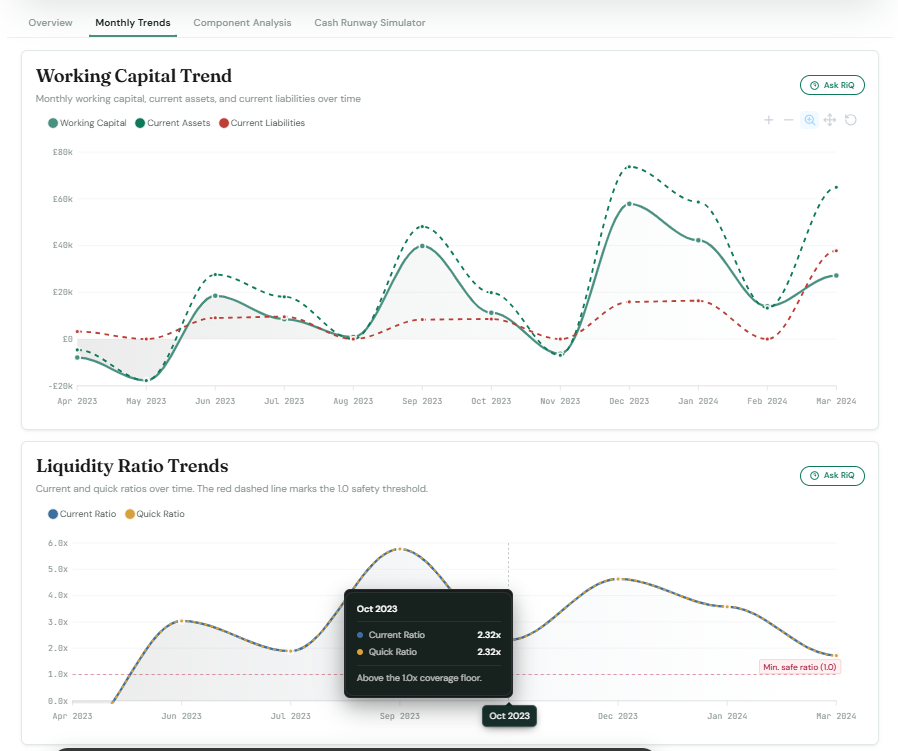
Liquidity, month by month
LedgerIQ’s liquidity ratios, working capital, and debt and leverage modules read the balances straight from the ledger. The current ratio and quick ratio are drawn as a trend against the 1.0 line, with working capital, current assets and current liabilities beside them, and RiQ explains what moved them.
- Current and quick ratios for every month, with the trend
- Gearing, debt to equity and interest cover from the same ledger
- Working capital, and what it is made of
A full LedgerIQ analysis is 1,000 credits, and every account starts with 1,000. See LedgerIQ.
02
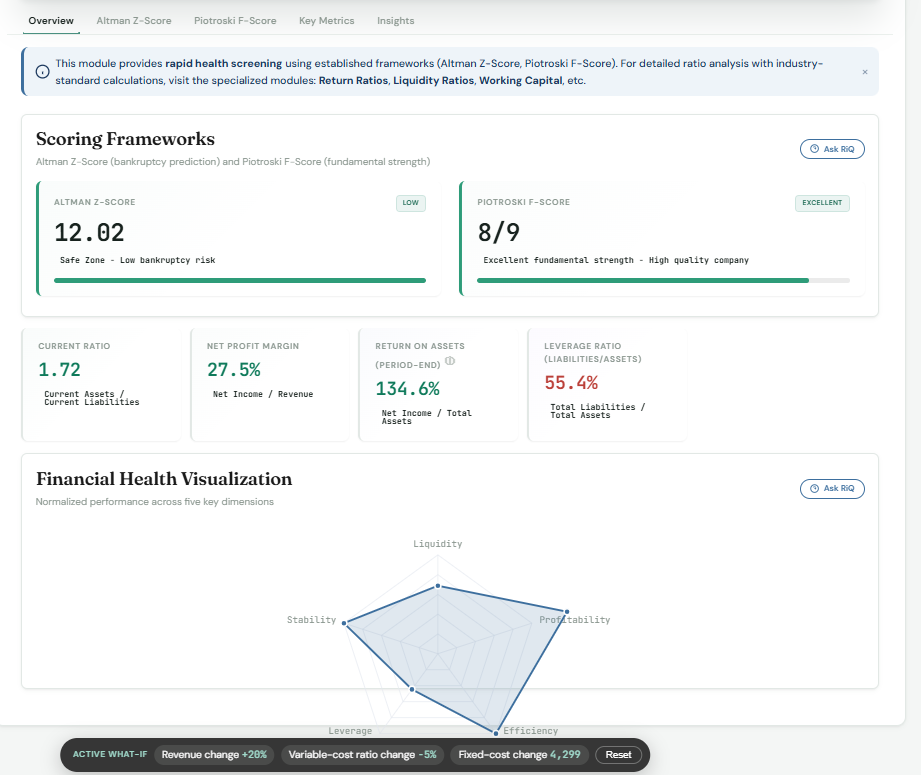
A health check, built from the ratios
The financial health module puts the ratios together: the current ratio and liabilities to equity alongside Altman’s Z′-score for private companies and the Piotroski F-score, combined into one score with the reasoning listed. Every figure comes from the ledger, so it can be traced back to the entries behind it.
- Altman Z′ and Piotroski F-score from the general ledger
- Current ratio and liabilities to equity in the same view
- Board pack PDF with the narrative written by RiQ
IQ Books keeps a business’s books, and the balance sheet, current every day; one organisation with the whole ledger is free. See IQ Books.
Guide
Gearing and liquidity, worked out
The gearing ratio formula and how to calculate it, the two definitions in use, what a good gearing ratio looks like, and the current ratio, quick ratio and interest cover beside it.
What is the gearing ratio?
The gearing ratio, sometimes called the capital gearing ratio, financial gearing or leverage, measures how much of a business’s long-term finance is borrowed rather than put in by its owners. The gearing ratio formula taught in UK business and accounting courses, including A level business, is:
Gearing ratio = long-term liabilities ÷ capital employed × 100
Capital employed is equity (share capital plus retained earnings) plus long-term liabilities, which are loans due in more than one year, preference shares and mortgages.
How to calculate gearing ratio
The gearing ratio calculation needs two lines from the balance sheet. Take the long-term borrowing from the balance sheet, add it to total equity to get capital employed, and divide. A company with £150,000 of long-term loans and £250,000 of equity has capital employed of £400,000, and a gearing ratio of £150,000 ÷ £400,000 × 100 = 37.5%. The calculator above shows the same workings for your own figures.
Gearing, debt to equity and net gearing
Not everyone means the same thing by gearing, so it is worth saying which one you are quoting:
- Gearing on capital employed: long-term borrowing ÷ (equity + long-term borrowing). The textbook definition above: 37.5% in the example.
- Gearing on all borrowing: the overdraft and short-term loans included, over borrowing plus equity. With £30,000 of short-term borrowing: £180,000 ÷ £430,000 = 41.9%.
- Debt to equity ratio: the debt to equity ratio formula is total borrowing ÷ equity, often written as a ratio rather than a percentage: £180,000 ÷ £250,000 = 0.72, or 72%. To calculate debt to equity, use the same borrowing figure you would for gearing, so the two can be compared.
- Net gearing: borrowing less cash, over equity. With £40,000 in the bank: (£180,000 − £40,000) ÷ £250,000 = 56%. Banks and analysts often quote this one.
What is a good gearing ratio?
A business with a gearing ratio of more than 50% is traditionally said to be highly geared, and one under 25% is traditionally described as having low gearing; between the two is usual for an established business that is comfortable borrowing. A high gearing ratio means more of the business is funded by lenders, so more of its profit goes on interest, and a fall in profit hits the owners harder; a low gearing ratio means less risk but possibly slower growth. What is comfortable depends on how steady the profits are: a business with long contracts can carry more borrowing than one with lumpy sales. A good debt to equity ratio follows the same logic, and a lender will usually set its own limit in the loan agreement.
The current ratio: meaning and formula
The current ratio, sometimes called the working capital ratio, compares what is due to be paid within a year with what will turn into cash within a year. The current ratio formula is:
Current ratio = current assets ÷ current liabilities
With current assets of £180,000 and current liabilities of £110,000, the current ratio calculation is £180,000 ÷ £110,000 = 1.64, often written 1.64 : 1. Guidance from BDC, Canada’s business development bank, is that a current ratio of 1.0 or more is acceptable for most businesses, 1.2 to 1 or higher generally provides a cushion, and one above 2.0 can mean too much is tied up in current assets that could be used better. So is 1.2 a good current ratio? On that guidance it is a cushion, if a thin one. What does a current ratio of 2.5 mean? Plenty of cover, and possibly stock or debtors that are not working hard enough.
The quick ratio (acid test ratio)
The quick ratio, also called the acid test ratio, is stricter: it leaves out stock, the current asset that is slowest to turn into cash. The quick ratio formula is:
Quick ratio = (current assets − stock) ÷ current liabilities
The quick ratio calculation for the example: (£180,000 − £50,000) ÷ £110,000 = 1.18. A ratio of 1 or higher typically indicates good financial health. The gap between the current ratio and the quick ratio shows how much the business is relying on selling its stock to pay its bills.
Interest cover
The interest cover ratio is how many times the year’s profit covers the interest on the borrowing. The interest cover formula is:
Interest cover = operating profit ÷ interest payable
With operating profit of £60,000 and interest of £9,000, interest cover is 6.7 times. There is no single safe level: lenders often set a minimum in the loan agreement, so check your covenant. Below 1, the profit does not cover the interest at all.
Checked on 9 October 2026: tutor2u, Gearing ratio and Acid test ratio; BDC, Current ratio. This calculator is a guide to the arithmetic, not advice.
Questions
Gearing and liquidity, answered
About the gearing ratio formula, what a good figure looks like, the current and quick ratios, interest cover, and what LedgerIQ does with them.
What is the gearing ratio?
The gearing ratio measures how much of a business’s long-term finance is borrowed rather than provided by its owners. It is also called the capital gearing ratio, financial gearing or leverage. A higher figure means more of the business is funded by lenders.
What is the gearing ratio formula?
The formula used in UK textbooks is long-term liabilities ÷ capital employed × 100, where capital employed is equity plus long-term liabilities. With £150,000 of long-term loans and £250,000 of equity, gearing is £150,000 ÷ £400,000 × 100 = 37.5%. Some lenders and analysts use total borrowing over borrowing plus equity, or debt to equity, instead.
What is a good gearing ratio?
A business with gearing of more than 50% is traditionally said to be highly geared, and one under 25% to have low gearing, with 25% to 50% usual for an established business. What suits a business depends on how steady its profits are, and a lender will usually set its own limit in the loan agreement.
What does a high gearing ratio mean?
It means a large share of the business is funded by borrowing. More of the profit goes on interest and repayments, and a fall in profit hits the owners harder, so the business is more exposed to rising interest rates and a bad year. In a good year, though, the owners keep more of the gain.
What is the difference between gearing and debt to equity?
Both compare borrowing with the owners’ money. Gearing divides borrowing by the total of borrowing and equity, so it runs from 0% to 100%; debt to equity divides borrowing by equity alone, so it can run past 1. With borrowing of £180,000 and equity of £250,000, gearing on all borrowing is 41.9% and debt to equity is 0.72.
What is net gearing?
Net gearing is borrowing less cash, divided by equity. It allows for cash in the bank that could repay part of the borrowing: with borrowing of £180,000, cash of £40,000 and equity of £250,000, net gearing is 56%.
How do you calculate the current ratio?
Divide current assets by current liabilities. With current assets of £180,000 and current liabilities of £110,000, the current ratio is 1.64, or 1.64 : 1. It is sometimes called the working capital ratio.
What is a good current ratio?
BDC, Canada’s business development bank, says a current ratio of 1.0 or more is acceptable for most businesses and 1.2 to 1 or higher generally provides a cushion, while one above 2.0 can mean too much is tied up in current assets. Compare it with the business’s own trend and sector rather than one rule.
What is the quick ratio?
The quick ratio, also called the acid test ratio, measures whether a business could pay its debts due within a year from its current assets without selling any stock. The quick ratio formula is (current assets − stock) ÷ current liabilities; with current assets of £180,000, stock of £50,000 and current liabilities of £110,000, it is 1.18.
What is the difference between the current ratio and the quick ratio?
The quick ratio, or acid test, leaves stock out: (current assets − stock) ÷ current liabilities. It shows whether the business could pay its short-term debts without selling stock, so it is the stricter of the two. A ratio of 1 or higher typically indicates good financial health.
How do you calculate interest cover?
Divide operating profit, profit before interest and tax, by the interest payable for the year. With operating profit of £60,000 and interest of £9,000, interest cover is 6.7 times. Lenders often set a minimum in the loan agreement, and below 1 the profit does not cover the interest.
Does LedgerIQ calculate these ratios?
Yes. LedgerIQ reads the general ledger, from IQ Books or an export from Xero, QuickBooks, Sage or any other platform, and works out the liquidity ratios, gearing, debt to equity and interest cover for every month, with the trend, a health score and RiQ’s explanation. A full analysis is 1,000 credits.
Does this calculator store or send my figures?
No. Every sum runs in your browser. Nothing you type is sent to ReconcileIQ or anyone else, and nothing is saved when you close the page.
The ratios, every month, from the ledger.
LedgerIQ works out gearing, liquidity and interest cover from the general ledger, with the trend and RiQ’s explanation. IQ Books keeps the balance sheet behind them current, and one organisation with the whole ledger is free.