Business valuation calculator: what is your business worth?
Enter a year’s turnover and profit and see what a business or company might be worth four ways at once: an earnings multiple (EBITDA, or SDE if you run it yourself), a revenue multiple, a discounted cash flow and net assets. You get a range rather than one number, converted into a value for the shares, with the working shown and every assumption yours to change. It works as a company valuation calculator for a limited company, and for a sole trader or partnership business too.
Every sum runs in your browser. Nothing you type is sent to us or saved.
Value of the shares · owner-run, on SDE
The middle of the four methods.
| Method | Low | Middle | High |
|---|
Value it from the real ledger. LedgerIQ reads your general ledger, finds the add-backs and runs six methods with 10,000 simulations.
Try LedgerIQ freeThis free business valuation calculator is a guide to the arithmetic of a valuation, not a valuation. The multiples and rates are yours to set and the defaults are illustrative. A buyer pays what a buyer will pay, and a valuation for a sale, a divorce, a dispute or a tax purpose needs a professional valuer.
LedgerIQ by ReconcileIQ
The same valuation, from the real ledger
This calculator runs on the figures you type. LedgerIQ reads the company’s general ledger, from any accounting software or live from IQ Books, so the profit is normalised from the actual transactions and the range comes from 10,000 simulations, not one set of guesses.
01
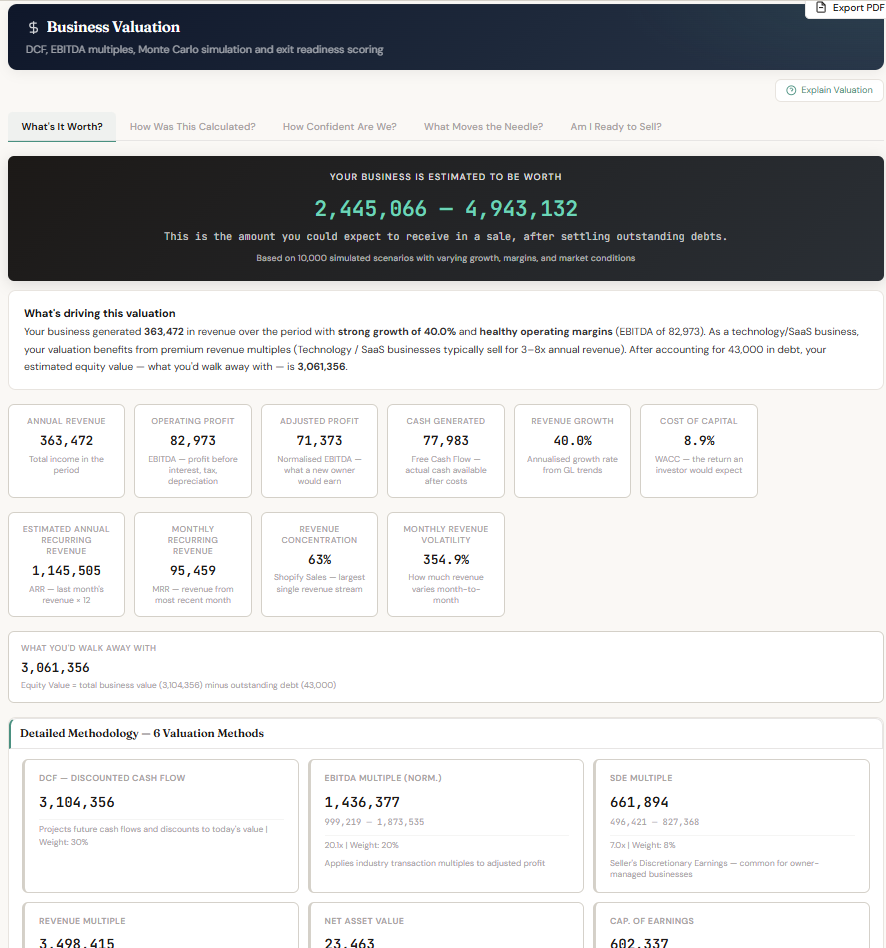
Six methods, one answer
LedgerIQ values the business by discounted cash flow, EBITDA multiple, SDE multiple, revenue multiple, net asset value and capitalisation of earnings, then shows how far the methods agree and where the value most likely sits. Every figure links back to the ledger it came from.
- Six methods, each with its low, middle and high
- Business value before debt, and the bridge to the shares
- A plain-English note on what drives the range
02
The add-backs, found for you
Normalising the profit is where most valuations go wrong. LedgerIQ scans the nominal accounts for the usual suspects, such as director’s personal costs, entertaining, one-off and exceptional items and losses on disposal, and picks out the owner’s pay. You tick the ones that are genuinely not part of the business, and the normalised EBITDA and SDE follow.
- Likely add-backs suggested from the account names and unusual transactions
- Owner’s pay detected, with a market salary to set against it
- Every adjustment visible in the working
03
10,000 simulations, not one guess
A discounted cash flow is only as good as its growth and discount rates. LedgerIQ runs the cash-flow valuation 10,000 times with those assumptions varied, and shows the spread from the 10th to the 90th percentile, so you can see how confident the number really is before anyone negotiates on it.
- 10,000 Monte Carlo runs of the cash-flow valuation
- 10th, 25th, 50th, 75th and 90th percentiles
- A chart of how often each value came up
04
And the rest of the picture
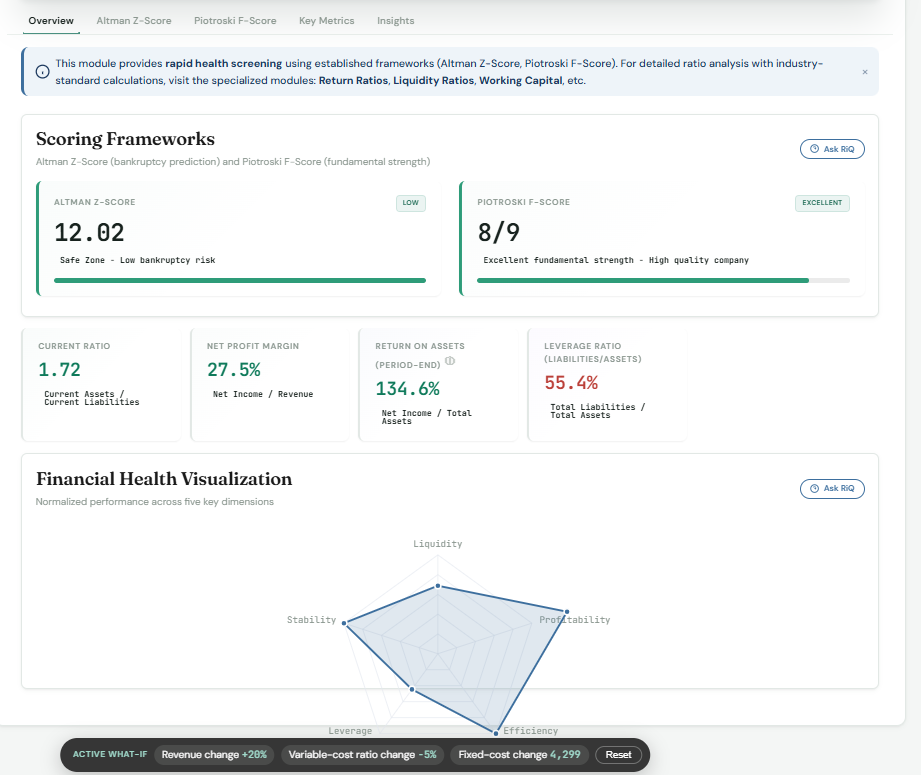
A buyer asks more than how much the business is worth. The same upload runs all 44 LedgerIQ modules: the statements, margins, cash conversion, working capital, the Altman Z-Score and Piotroski F-Score, forecasts and anomaly checks, with a PDF board pack and Excel exports. It is the pack you would want in a data room.
- 44 analysis modules from one general ledger export
- Financial health scored with the Altman Z-Score and Piotroski F-Score
- PDF board pack and Excel export of any module
See every module on the LedgerIQ page.
Your first analysis, free
Every new account starts with 1,000 credits, and a full LedgerIQ analysis, valuation and all 44 modules included, uses 1,000. Upload a general ledger export as CSV or Excel from any accounting software, or connect IQ Books, and the valuation is ready in about a minute.
Every month, every client
Paid plans, from £5 a month, add monthly credits for more analyses, along with Bank Reconciler, CodeIQ and the full IQ Books ledger. Practices can run it on every client’s ledger.
Guide
How to value a business in the UK
The methods behind the calculator, what each one assumes, and the UK adjustments that turn a business value into a price for the shares.
How to calculate a business valuation, step by step
Whether you are selling, buying, bringing in a partner or just want to know what your company is worth, the same five steps apply.
- Start from a year’s profit, not the turnover. Take operating profit, the profit before interest and tax, and add back depreciation and amortisation to reach EBITDA.
- Normalise it. Add back one-off costs and anything personal run through the business, take out one-off income, and put the owner’s pay on a market footing. This is the step that moves the value most.
- Apply a multiple. Multiply normalised EBITDA, or SDE for an owner-run business, by a multiple that reflects size, risk, how much the business relies on you and how predictable its income is.
- Cross-check. Compare a discounted cash flow, a revenue multiple and the net assets. If they disagree wildly, find out why before you trust any of them.
- Go from business value to share value. Add the cash in the business and take off its borrowings. Most UK sales of small companies are agreed on that cash-free, debt-free basis.
Business valuation methods in this calculator
No single method is right. Each answers a slightly different question, which is why the calculator shows them side by side, and each has its own business valuation formula, shown below. A business valuation based on profit uses an earnings multiple; the others use sales, future cash or assets, and the business valuation multiples are always yours to set. For the six methods LedgerIQ uses in more depth, see our guide to valuing a business from its general ledger.
EBITDA multiple
EBITDA is earnings before interest, tax, depreciation and amortisation: the profit the business makes from trading, before how it is financed and before the non-cash charge for wearing out its assets. An EBITDA multiple values a business that would run without its owner, with a market salary in the costs for whoever runs it.
Business value = normalised EBITDA × EBITDA multiple
Suits: established, profitable businesses with a management team. Watch: it ignores how much the business needs to spend on equipment, so two firms with the same EBITDA but very different investment needs can look alike.
SDE multiple
SDE, seller’s discretionary earnings, is EBITDA with the owner’s whole pay added back, because whoever buys a small owner-run business usually steps into the owner’s role and pays themselves out of the profit. SDE is higher than EBITDA for the same business, so it is paired with a lower multiple.
SDE = EBITDA + owner’s pay + one-off and discretionary costs
Suits: small businesses that rely on one owner day to day, such as a trade, a shop or a small agency, which is why SDE is the usual starting point for how to value a small business. Watch: do not count a full owner’s salary in SDE and then use an EBITDA multiple on it; the two go in pairs.
Revenue multiple
A revenue multiple values the sales, not the profit. It is used where profit is low or being reinvested in growth, for recurring-revenue businesses, and as a sense check.
Business value = turnover × revenue multiple
Suits: fast-growing or subscription businesses, and comparing like with like in one sector. Watch: it says nothing about margin; two businesses with the same turnover can be worth very different amounts.
Discounted cash flow (DCF)
A DCF values the cash the business will generate in future, brought back to today at a rate that reflects the risk. The calculator projects five years of free cash flow at your growth rate, adds a terminal value for every year after that, and discounts it all at your discount rate. If you leave free cash flow blank, it estimates it as normalised EBITDA less an allowance of 25% for corporation tax, and assumes spending on equipment roughly matches depreciation.
Value = the sum, for years 1 to 5, of FCF in year t ÷ (1 + r)^t, plus terminal value ÷ (1 + r)^5
Terminal value = FCF in year 5 × (1 + g) ÷ (r − g), where r is the discount rate and g the long-term growth
Suits: businesses with predictable cash flows. Watch: it is very sensitive to the discount rate and the long-term growth rate, which is why the calculator shows it two points either side of your rate. The discount rate for a small private company is usually much higher than for a listed one, because it carries more risk.
Net asset value
Net asset value is what the company owns minus what it owes, ideally with property, stock and equipment at what they would really fetch rather than their book value. It ignores what the business can earn, so for a profitable trading business it is a floor, shown on the chart as a dashed line.
Suits: property and investment companies, asset-heavy businesses, and a business that makes little profit. Watch: book values can be well above or below market values.
Normalising the profit
Buyers pay for the profit the business will make for them, not the profit in the accounts. Three adjustments do most of the work:
- The owner’s pay. Many owner-managers of UK companies take a small salary and the rest as dividends, so the accounts understate the cost of running the business. For an EBITDA valuation, replace your salary in the costs with what it would cost to employ someone to do your job. For SDE, add your pay back in full.
- One-offs. Add back costs that will not recur, such as a legal case, a move or a bad debt from a customer who has gone, and take out one-off income, such as a grant or a profit on selling an asset.
- Personal costs. Anything personal paid through the business should be added back, and a buyer will expect to see the evidence.
From business value to the price of the shares
This is the step that separates how to value a business from how to value a company’s shares. Earnings multiples and a DCF give a business value before debt, often called enterprise value. To reach the value of the shares, add the cash in the business and take off its borrowings: bank loans, overdrafts, finance leases and money owed to directors. The calculator shows both.
A director’s loan account needs care. On GOV.UK’s definition, a director’s loan is money you take from your company that is not salary, dividends or an expense repayment. If the account is overdrawn, you owe the company and it is an asset of the company; if it is in credit, the company owes you and a buyer will treat it as a debt. It is usually settled before or at completion.
Goodwill
Goodwill is the part of the price above the net assets: what a buyer pays for the customers, the reputation, the people and the profit the business earns. In the calculator it is the gap between the dashed net assets line and the earnings-based range. A business that relies heavily on its owner usually has less transferable goodwill, which is one reason buyers ask owners to stay on for a handover.
When you need a professional valuation
Use the calculator to understand the range and the drivers before you talk to anyone. For a business valuation for sale, the price is set by negotiation with a buyer, and a valuation that has to stand up, for a divorce, a dispute between shareholders, a shareholder leaving or a tax purpose such as transferring shares, should come from a professional valuer.
If you would rather work through a DCF yourself, our free DCF valuation template for Excel lays the same calculation out line by line.
Checked against GOV.UK on 9 October 2026: Corporation Tax rates (the 25% main rate used in the free cash flow estimate; profits of £50,000 or less pay 19%) and director’s loans. This calculator is a guide to the arithmetic, not a valuation or financial advice.
Questions
Business valuation, answered
About valuing a UK business, this calculator, and what LedgerIQ does from the ledger.
How much is my business worth, and how do I value it?
Start from profit, not turnover. Take the last year's operating profit, add back depreciation, one-off costs and anything personal run through the business, and put the owner's pay on a market footing. Multiply that normalised profit by a multiple that reflects the business's size, risk and growth, then add the cash in the business and take off its debts to get a value for the shares. Check the answer against a cash-flow valuation and against net assets. The calculator above does all four side by side.
What is a business valuation?
A valuation of a business is an estimate of what it would change hands for between a willing buyer and a willing seller. It is usually worked out several ways, most often from its profit with an earnings multiple, cross-checked against its future cash flows, its sales and its net assets, and given as a range. A company valuation is the same exercise for a limited company, finished by turning the business value into a value for the shares.
Is a business worth 3 times profit?
Sometimes, but there is no fixed multiple. Three times profit is a rule of thumb, and the right multiple depends on which profit you mean (SDE, EBITDA and profit after tax give very different answers), how much the business depends on its owner, how predictable its income is, its size and its growth. A larger business with a management team and recurring income usually earns a higher multiple than a small owner-run one. Treat any multiple as the start of a negotiation, not a price.
What are the main business valuation methods?
Most small and medium-sized business valuations use one or more of four: an earnings multiple (EBITDA, or SDE for an owner-run firm), a revenue multiple, a discounted cash flow and net asset value. Earnings multiples are the most common for profitable trading businesses, a discounted cash flow suits businesses with predictable cash flows, revenue multiples are used where profit is low or reinvested, and net assets give a floor or suit asset-heavy businesses. A sensible valuation compares several.
What is SDE?
SDE, seller's discretionary earnings, is the profit a single owner-operator takes out of a business: profit before interest, tax, depreciation and amortisation, plus the owner's own salary and benefits, plus one-off and discretionary costs. It is used to value small owner-run businesses because the buyer will usually step into the owner's role. EBITDA, by contrast, assumes the owner is replaced by a paid manager.
What is the difference between EBITDA and SDE?
Both start from profit before interest, tax, depreciation and amortisation. SDE then adds back the owner's whole pay, because a buyer will do the owner's job. EBITDA keeps a market-rate salary for whoever runs the business. SDE is therefore higher than EBITDA for the same business, and it is paired with lower multiples. Use SDE for a business that relies on its owner day to day, and EBITDA for one that would run without them.
What is asset-based valuation?
An asset-based valuation, or net asset value, is what the company owns minus what it owes: the total assets on the balance sheet less all its liabilities, ideally with property, stock and equipment restated at what they would really fetch. It ignores the profits the business can earn, so for a profitable trading business it is usually a floor, and the gap between it and an earnings-based value is the goodwill. For a property company or an asset-heavy business it can be the main method.
How do I value a small business in the UK?
A small business valuation works the same way, with two UK points to watch. Most small business sales are agreed cash-free and debt-free, so the earnings-based value is adjusted for cash, loans and overdrafts to reach the price for the shares. And the director's loan account has to be settled or allowed for: if a director owes the company money it is an asset of the company, and if the company owes the director it is a debt. Price the business on normalised profit, then make those adjustments.
How do I value a company?
To value a company, value its business first, then turn that into a value for the shares. Work out normalised EBITDA, or SDE if one owner runs it, apply a multiple, and cross-check with a discounted cash flow and the net assets. That gives the business value before debt, sometimes called enterprise value. Add the company's cash and take off its borrowings, including any money it owes to directors, and the result is the value of the shares. The calculator shows both figures.
How much is a business worth with £1,000,000 in sales?
Sales alone do not tell you. Two businesses with £1,000,000 of turnover can be worth very different amounts if one makes £200,000 of profit and the other breaks even. Revenue multiples are used, usually alongside profit-based methods, where profit is low or being reinvested in growth, and the multiple varies widely by sector and margin. Enter the turnover and the profit above to see both views.
What if my business makes a loss?
Earnings multiples and a discounted cash flow do not work on a loss, so the calculator marks them as not meaningful. The value then rests on the revenue multiple, if a buyer would pay for the sales, and on net assets. If the loss comes from one-off costs or from the owner's pay, add those back first: the normalised profit may be positive.
Can I use this calculator for a sale, a divorce or tax?
Use it to get a sense of the range before you talk to anyone. It is not a formal valuation. A sale price is whatever a buyer will pay, and a valuation for a divorce, a dispute between shareholders or a tax purpose, such as transferring shares, needs a professional valuer who can stand behind it.
Does this calculator store or send my figures?
No. Every calculation runs in your browser. Nothing you type is sent to ReconcileIQ or anyone else, and nothing is saved when you close the page.
How does LedgerIQ value a business?
LedgerIQ reads the company's general ledger export, from any accounting software or live from IQ Books. It suggests the add-backs itself, such as director's personal costs, entertaining, one-off items and losses on disposal, along with the owner's pay, and you confirm them. It then values the normalised business six ways, by discounted cash flow, EBITDA multiple, SDE multiple, revenue multiple, net asset value and capitalisation of earnings, and runs 10,000 Monte Carlo simulations of the cash-flow valuation to show the range from the 10th to the 90th percentile. A full analysis uses 1,000 credits, and every new account starts with 1,000.
Stop guessing what the business is worth.
LedgerIQ reads the general ledger, normalises the profit from the actual transactions and values the business six ways with 10,000 simulations, alongside 44 modules of analysis. Every new account starts with enough credits for a full analysis.