Free cash flow forecast template for UK businesses
Build a 12-month or 13-week cash flow forecast here, with each receipt and payment in the period the money really moves: customers who pay after 45 days, PAYE on the 22nd, VAT a month and seven days after each quarter, corporation tax nine months and a day after the year end. You see the lowest bank balance and when it comes, and you can download the forecast as an Excel template with live formulas.
Everything runs in your browser. Nothing you type is sent to us or saved.
Cash flow forecast
The lowest month-end bank balance.
The line is the closing bank balance; the bars are each period’s net cash flow. The filled dot is the lowest point.
Forecast from the real books. LedgerIQ reads a general ledger and projects the cash from the business’s own history, with a likely range and the runway.
Try LedgerIQ freeThe forecast, line by line
Type over any cell to change it, for a one-off payment, a big order or a quiet month.
This free cash flow forecast template is a planning aid. It adds up what you enter and places the UK tax payments on their usual due dates; it cannot see your bank account or your books, and it does not model corporation tax instalments for large companies, the VAT annual accounting scheme or payments on account, or bank holidays. Check the dates that matter to you with HMRC.
LedgerIQ by ReconcileIQ
The same forecast, from the real ledger
This template runs on the figures you type. LedgerIQ reads the business’s general ledger, from any accounting software or live from IQ Books, and forecasts from what the books actually show: the seasonality in the sales, how fast customers really pay, the costs that recur. It is cash flow projection software for the person who has to stand behind the numbers.
01
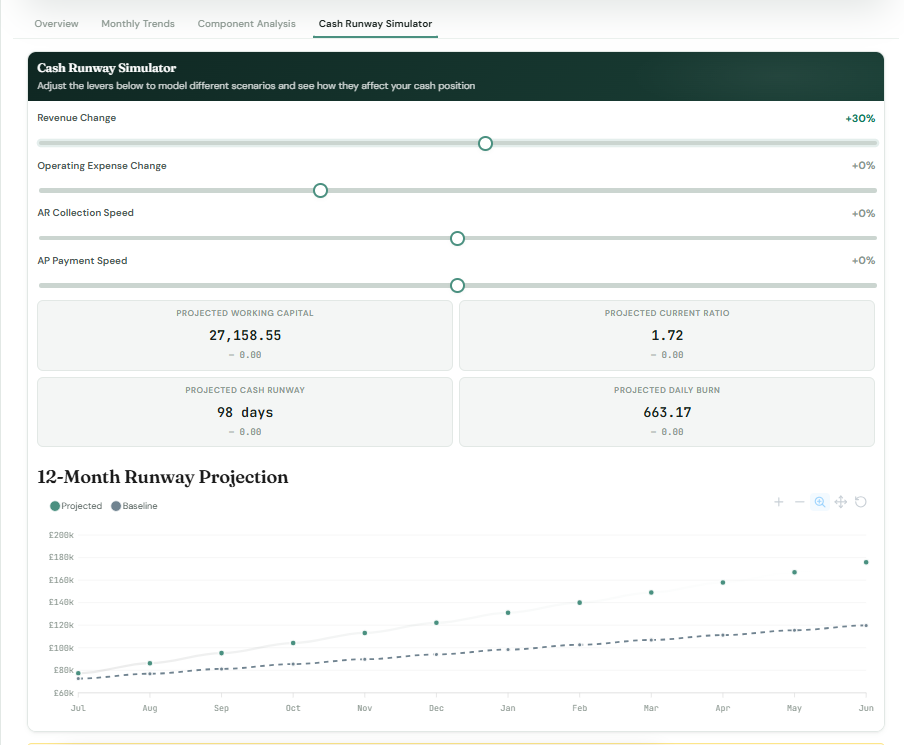
The runway, in three cases
LedgerIQ’s forward cash flow forecast projects the cash position from the ledger’s own operating, investing and financing history, combining several forecasting methods into one projection with a likely range. It shows how many months the cash lasts in an expected, a best and a worst case, and the working capital what-if lets you move sales, costs and collection speed to see what changes.
- A projection with a likely range, not one guess
- Cash runway in expected, best and worst cases
- Collection and payment speed as levers
02
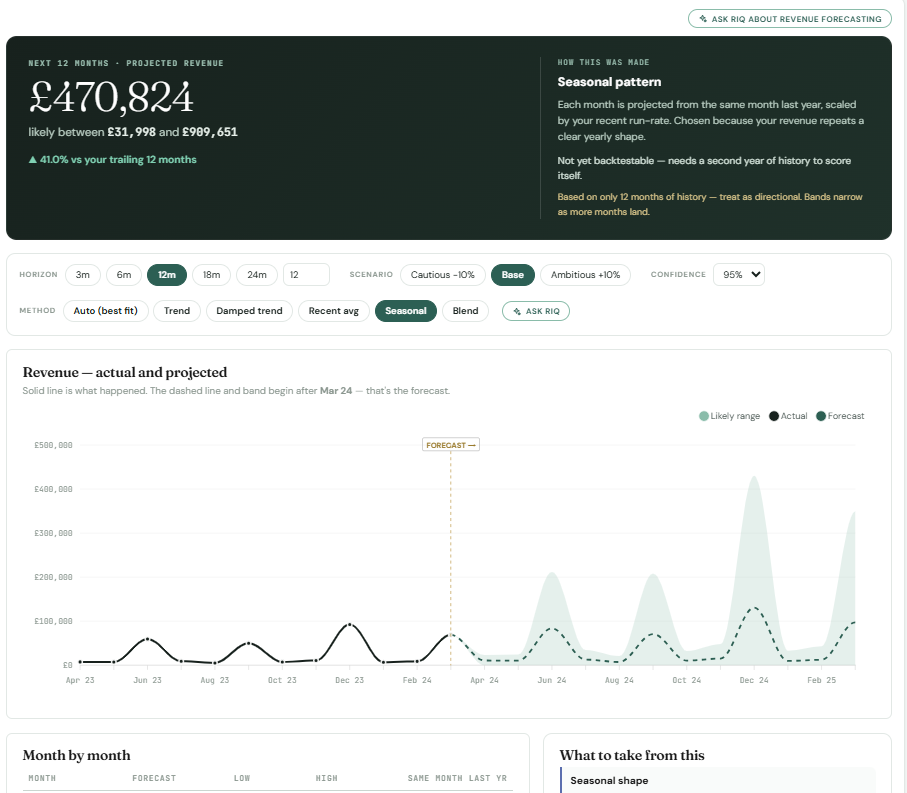
Sales forecast from the history
Revenue forecasting tries several methods on the business’s own monthly sales, trend, damped trend, seasonal and a blend, and tests them against the history where there is enough of it, so the forecast it picks is the one that would have been right. You get the next 12 months with a likely range, and a cautious and an ambitious case.
- Seasonal patterns from last year’s months
- Methods tested against your own history
- A likely range and scenarios
03
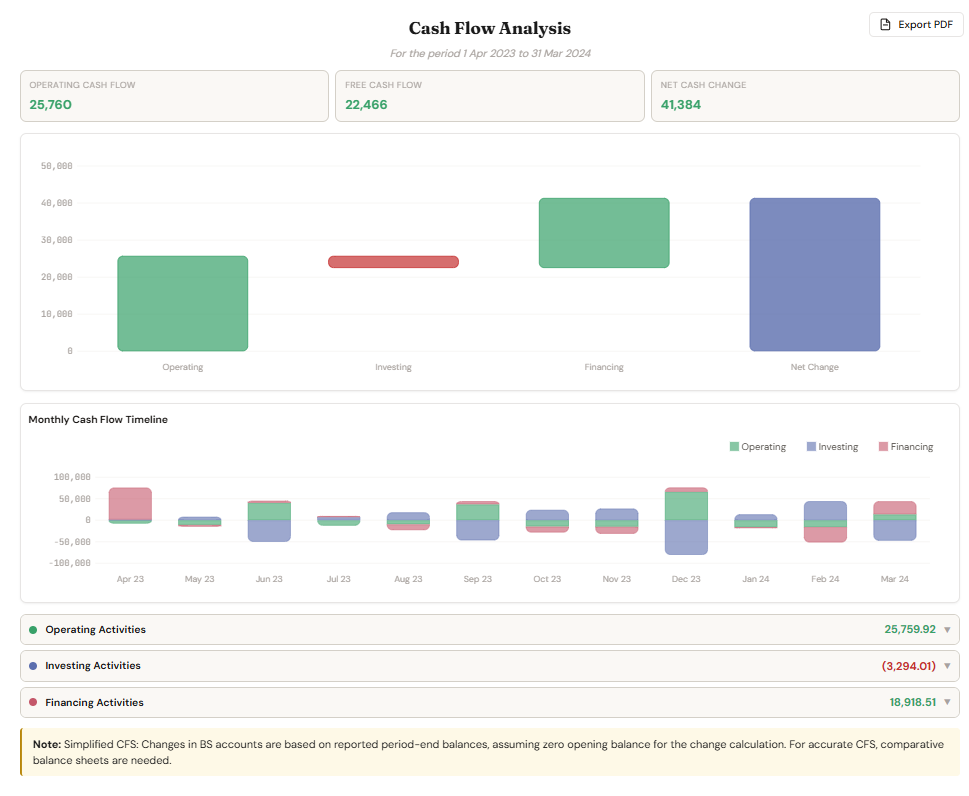
The cash flow statement, and a three-way forecast
Looking back, LedgerIQ draws the cash flow statement from the ledger’s movements, operating, investing and financing, month by month, reconciled to the bank accounts. Looking forward, its three-way forecast projects the profit and loss, the balance sheet and the cash flow together from one set of assumptions, debtor and creditor days included, so the balance sheet still balances.
- Indirect cash flow statement from the general ledger
- Profit and loss, balance sheet and cash projected together
- Debtor, creditor and stock days as drivers
04
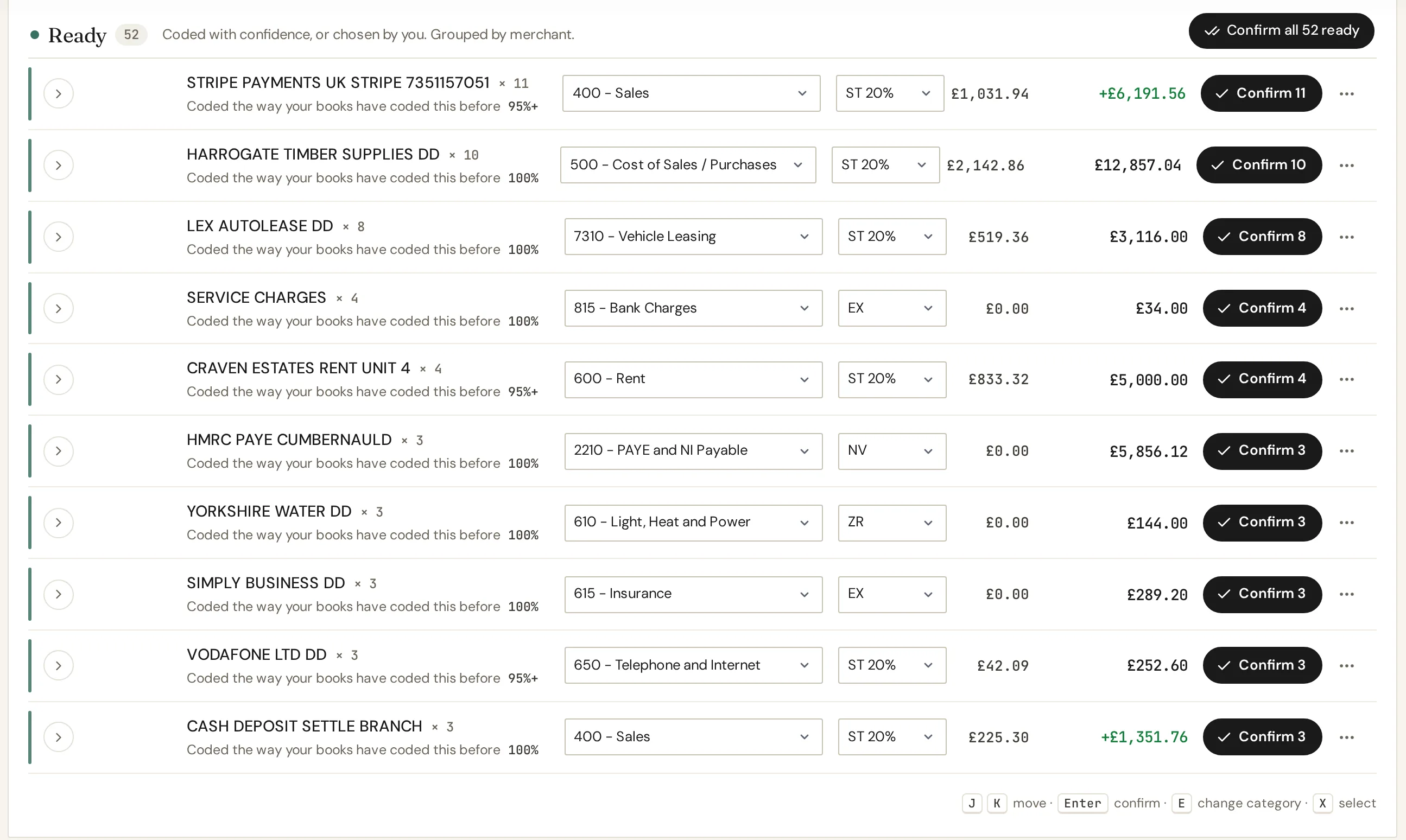
An opening balance that is real
In IQ Books, the free accounting platform at the centre of ReconcileIQ, live bank feeds bring each day’s lines in by themselves, already coded by CodeIQ, with a health check against the bank balance. The bank balance a forecast starts from is the real one, and the VAT and tax figures come from the books.
- Live bank feeds, lines coded on arrival
- A running balance for every bank account
- VAT returns filed from the books
Included with every plan
LedgerIQ is part of every ReconcileIQ plan, the free tier too. A full analysis of a general ledger uses 1,000 credits, and every new account starts with 1,000, so you can run your first forecast from the real books before paying anything.
Every month, every client
Paid plans, from £5 a month, add monthly credits: Starter’s 5,000 cover five full analyses a month. Practices run LedgerIQ across every client’s ledger, along with Bank Reconciler, CodeIQ and the full IQ Books ledger.
Guide
How to do a cash flow forecast in the UK
What a cash flow forecast is, how to build one line by line, when VAT, PAYE and corporation tax really leave the account, a worked example, and what to do with the lowest point once you have found it.
What is a cash flow forecast? The meaning, in plain English
Put simply, the definition of a cash flow forecast, or of a cash flow projection, is an estimate of the money that will come into and go out of a business bank account over the coming months or weeks, and the balance it leaves at the end of each one. It is built from the bank balance today, not from the profit and loss account, and every receipt and payment goes in the period the cash actually moves. That is why its purpose is different from a budget: a profitable business can still run out of cash in the month its customers are slow, its VAT quarter is due and the corporation tax lands together, and the cash flow forecast is what shows it coming. Explained in one line: profit tells you whether the business makes money, the cash flow forecast tells you whether it will have the money when the bills are due.
Cash flow forecast or cash flow projection?
The two terms mean the same thing. “Cash flow projection” tends to be used for longer views, such as the three-year cash flow projections a lender or an investor asks for, and “cash flow forecast” for the working 12-month or 13-week view a business keeps up to date. The template on this page is a cash flow projection template as much as a forecast one: the method is identical, and the worked example below doubles as a sample cash flow projection for a year.
How to do a cash flow forecast, step by step
Whether you prepare a cash flow forecast here, create one in a cash flow forecast template in Excel or make one on paper, the steps are the same:
- Start from today’s bank balance. The real balance on the bank account, not the figure in last year’s accounts. An overdraft goes in as a minus.
- Forecast the money in, by when it arrives. Sales you will invoice, moved forward by the time your customers usually take to pay, plus what customers already owe you, plus any other income.
- Forecast the money out, by when it leaves. Suppliers after your usual payment time, wages, rent, overheads, loan repayments and what the owners take out.
- Put the tax on its due dates. VAT one calendar month and seven days after each VAT quarter, PAYE and National Insurance on the 22nd, corporation tax nine months and one day after the year end.
- Add up each period. Receipts minus payments is the net cash flow; the opening balance plus the net cash flow is the closing balance, which becomes next period’s opening balance.
- Find the lowest point. The lowest closing balance, and when it comes, is the number that matters: it tells you whether you need an overdraft, a loan, faster collections or a payment moved.
- Update it with the actual figures. Each month, replace the forecast for the month just gone with what really happened and roll the forecast forward a month. That habit is what makes a cash flow forecast accurate.
The cash flow forecast formula
Opening bank balance
+ receipts
− payments
= closing bank balance
That is how to calculate a cash flow forecast, and the same cash flow projection formula works for a three-year plan. Net cash flow is receipts minus payments, and the closing balance of each month or week is the opening balance of the next. The Excel download keeps these as live formulas, so you can type over any figure and the totals, net cash flow and balances recalculate.
What goes on each line
| Line | What to put in | When the cash moves |
|---|---|---|
| Receipts from customers | Sales you invoice, including VAT if you charge it, and what customers owe you today | After your debtor days: invoice date plus the time customers usually take to pay. Card and cash sales on the day. |
| Other income | Rent received, commission, interest | When it is paid to you |
| VAT repayments from HMRC | Only if you reclaim more VAT than you charge, for example in a quarter of heavy buying | Usually within 30 days of HMRC receiving the return |
| One-off receipts | A grant, the sale of an asset, a new loan, capital the owners put in | When it arrives |
| Payments to suppliers | Stock and materials, including VAT, and what you owe suppliers today | After your creditor days |
| Wages | Net pay, what reaches the staff’s accounts | Payday |
| PAYE and National Insurance | Income tax deducted, employee and employer NI, student loans | The 22nd of the following tax month, or quarterly |
| Rent, overheads, loans | Rent, utilities, insurance, software, loan and hire purchase repayments | On their payment dates; rent is often quarterly in advance |
| VAT to HMRC | The VAT you charged less the VAT you can reclaim, for each quarter | One calendar month and seven days after the quarter ends |
| Corporation tax | The tax for the last accounting period | Nine months and one day after the year end |
| Drawings or dividends | What the owners take out | When it is paid |
| One-off payments | Equipment, a vehicle, a deposit, a tax bill from an earlier year | When it is paid |
When VAT is paid
For most VAT-registered businesses, the VAT return and the VAT payment are both due one calendar month and seven days after the end of the VAT period: VAT for the quarter to 31 March is due by 7 May, for the quarter to 30 June by 7 August. If you pay by Direct Debit, HMRC collects it three working days after the deadline. Your VAT quarters can end in March, June, September and December, or in one of the other two patterns; the template lets you pick yours.
Under standard VAT accounting the VAT is worked out on the invoices you issue and receive in the quarter, whether or not they have been paid. On the Cash Accounting Scheme you pay VAT on your sales when your customers pay you and reclaim it on purchases when you pay your suppliers, which moves the VAT bill nearer to the cash. A VAT repayment is usually made within 30 days of HMRC receiving the return, and the template puts it in at 30 days after the filing deadline, the cautious end. If you use the annual accounting scheme or make payments on account, your dates are different: add those payments to the table by typing them in.
When PAYE and corporation tax are paid
Employers pay PAYE and National Insurance to HMRC by the 22nd of the next tax month (the 19th by post), so the deductions from a payroll run in late September are due on 22 October. An employer that usually pays less than £1,500 a month may be able to pay quarterly, on 22 July, 22 October, 22 January and 22 April.
A company with taxable profits up to £1.5 million pays corporation tax nine months and one day after the end of its accounting period: for a year to 31 March 2026, on 1 January 2027. Larger companies pay in instalments, which this template does not model. Work out the amount with our corporation tax calculator.
A sole trader pays income tax through Self Assessment instead, with payments on account on 31 January and 31 July and a balancing payment on 31 January. Put those in the one-off payments line, in the months they fall.
A worked cash flow forecast example
This sample cash flow forecast is the worked example built into the template, so you can load it and change it.
Millbrook Joinery Ltd, an illustrative business, starts its 12-month cash flow forecast in October 2026 with £9,500 in the bank and a £10,000 overdraft facility. It invoices about £42,000 a month including VAT, growing by 1% a month, and its customers pay after 45 days. Materials cost £13,500 a month, paid after 30 days; wages are £9,800 net, PAYE and NI £3,900, rent £2,400, overheads £1,850, a loan £950 and dividends £3,000 a month. It owes £14,600 of VAT for the quarter to 30 September and £14,800 of corporation tax for the year to 31 March 2026.
| £ | Oct | Nov | Dec | Jan | Feb | Mar |
|---|---|---|---|---|---|---|
| Opening balance | 9,500 | 16,776 | 8,177 | 15,289 | 8,380 | (2,296) |
| Receipts | 42,711 | 40,966 | 42,947 | 43,291 | 38,891 | 45,583 |
| Payments | (35,435) | (49,565) | (35,835) | (50,200) | (49,567) | (36,706) |
| of which VAT | – | (14,600) | – | – | (15,473) | – |
| of which corporation tax | – | – | – | (14,800) | – | – |
| Closing balance | 16,776 | 8,177 | 15,289 | 8,380 | (2,296) | 6,581 |
The business is profitable and the forecast ends September 2027 at £32,691, but it dips to £2,296 overdrawn at the end of February, inside the facility, because January’s corporation tax is followed by the VAT for the October to December quarter on 7 February, in the shortest month for receipts. Knowing that in October, the directors can keep the overdraft in place, hold the dividend for two months or chase the slowest customers before Christmas. Load the worked example in the template to see the whole year; it starts from the current month, so its figures move a little from these.
The 13-week cash flow forecast
A 13-week cash flow forecast covers the next quarter week by week. It is the tool to reach for when cash is tight, a lender or an adviser asks for one, or a business is being refinanced or turned around, because weekly detail shows what a monthly forecast smooths over: the week wages and PAYE go out before the big customer receipts come in. Switch the template to 13 weeks and the same lines are placed by date, with monthly items such as rent, wages and PAYE in the week they fall. Many businesses keep a 13-week forecast for the next quarter and a 12-month cash flow forecast behind it.
Using the cash flow forecast template in Excel
The Excel download is your forecast as a working spreadsheet: one row for each line, one column for each month or week, and live formulas for the totals, the net cash flow, each period’s opening balance and the lowest closing balance. The blank cash flow forecast template has the same layout empty, with a 12-month sheet and a 13-week sheet and the UK tax dates as reminders, for anyone who wants a simple cash flow template to fill in by hand. Either opens in Excel, Google Sheets, Numbers or LibreOffice, and either works as a projected cash flow template for a business plan or as a cash flow report template for the board or the bank.
Cash flow forecasts in Xero and other software
Accounting software such as Xero can project the next few weeks from the invoices and bills already entered, so a Xero cash flow projection covers money you have already invoiced. A cash flow forecast like this one adds what is not in the software yet: next quarter’s sales, the tax dates, the dividend and the van you are about to buy.
Advantages and benefits of a cash flow forecast
- It shows a shortfall before it happens. Months of warning is the difference between arranging an overdraft calmly and an emergency call to the bank.
- It puts the tax in the diary. VAT, PAYE and corporation tax are large, fixed and predictable; a forecast stops them being a surprise.
- It tests decisions. A new hire, a vehicle, a dividend or a big contract on long payment terms: put it in and see what it does to the lowest point.
- Lenders and investors expect one. A loan application, a grant or a business plan usually needs cash flow projections, and a well-kept forecast makes the conversation shorter.
Disadvantages and limitations of a cash flow forecast
The drawbacks of a cash flow forecast are real, and worth knowing before you rely on one:
- It is only as good as its assumptions. Optimistic sales or customers who pay later than forecast make the bank balance worse than the forecast.
- It takes time to keep up to date. A forecast that is not updated monthly drifts away from reality within a quarter.
- It shows the month end, not the worst day. A monthly forecast can hide a dip in the middle of a month; a 13-week forecast shows it.
That is why a cash flow forecast is important for a business of any size: the disadvantages are about keeping it honest, and the advantages are about staying in control of the one thing that stops a business, running out of cash.
Cash flow forecast vs cash flow statement
A cash flow statement looks back. It is part of a set of accounts, shows where the cash came from and went in a period that has ended, and is usually split into operating, investing and financing activities. A cash flow forecast looks forward and is a management tool, not a statutory document. The statement is useful for checking last year’s forecast against what happened; LedgerIQ draws it from the general ledger.
Common cash flow forecasting mistakes
- Forecasting profit instead of cash. Sales go in when the money arrives, not when you invoice, and depreciation is not a payment.
- Leaving VAT out. Receipts and payments include VAT; the net VAT goes to HMRC on its own date.
- Forgetting PAYE, corporation tax and the owners’ drawings. They are certain and they are large.
- Assuming customers pay on time. Use the time they really take, which our debtor days calculator works out from your figures.
- Ignoring seasonality. A business that is quiet in January needs that in the forecast, which is what typing over a month’s figure is for.
- Building it once. The value is in updating it monthly against the bank.
Questions
Cash flow forecasts, answered
About cash flow forecasting, the UK tax dates, the template, and what LedgerIQ does for you.
What is a cash flow forecast?
A cash flow forecast is a month-by-month (or week-by-week) estimate of the money that will come into and go out of a business bank account, and the balance it leaves at the end of each period. It starts from today’s bank balance and puts each receipt and payment in the period the cash actually moves, so it shows when the business will be short of cash, not just whether it makes a profit.
How do I do a cash flow forecast?
Start with the bank balance today. List the money you expect to receive and put each amount in the month it will arrive, which for invoiced sales is after your customers’ usual payment time. List the payments the same way, including the tax dates: VAT, PAYE and corporation tax. Add up each month, carry the closing balance into the next month, and look for the lowest point. The template on this page does the arithmetic and the tax dates for you.
What is the formula for a cash flow forecast?
Opening bank balance plus receipts minus payments equals the closing bank balance, for each month or week. The closing balance of one period is the opening balance of the next. Net cash flow is receipts minus payments.
What is the difference between a cash flow forecast and a cash flow projection?
In practice they mean the same thing: an estimate of future cash in and out. “Projection” is often used for longer views, such as the three-year figures in a business plan or a loan application, and “forecast” for the working view of the next 12 months or 13 weeks that you update as you go.
What is the difference between a cash flow forecast and a cash flow statement?
A cash flow statement looks back: it is part of a set of accounts and shows where the cash came from and went in a period that has ended, usually split into operating, investing and financing activities. A cash flow forecast looks forward and is a management tool, not a statutory document. LedgerIQ produces the statement from a general ledger; this template builds the forecast.
How far ahead should a cash flow forecast go?
Twelve months is the usual horizon for running a business and planning tax payments, because it catches every VAT quarter and the corporation tax date. When cash is tight, or a lender or adviser asks for it, a 13-week forecast in weekly detail shows the next quarter precisely. Many businesses keep both and roll them forward each month.
What is a 13-week cash flow forecast?
A 13-week cash flow forecast covers the next quarter week by week. Weekly detail shows the pinch points a monthly forecast smooths over, such as wages and PAYE in one week and the big customer receipts in the next. It is the standard tool when a business is managing a tight overdraft, refinancing or being turned around. Switch the template to 13 weeks to build one.
What are the advantages and disadvantages of a cash flow forecast?
The advantages: it shows a cash shortfall months before it happens, so you can arrange finance, chase customers or move a payment in time; it puts the tax bills in the diary; and lenders and investors expect one. The disadvantages: it is only as good as its assumptions, it takes time to keep up to date, and it can give false confidence if receipts are optimistic. Updating it monthly with the actual figures is what keeps it useful.
Should a cash flow forecast include VAT?
Yes, if you are VAT registered. Customers pay you the VAT and you pay your suppliers the VAT, so receipts and payments go in including VAT, and the net VAT goes out to HMRC as a separate payment on its due date. Leaving VAT out makes the forecast look better than the bank account will be in the month the VAT bill is paid.
When is VAT paid to HMRC?
The VAT return and the payment are both due one calendar month and seven days after the end of the VAT period, so VAT for the quarter to 31 March is due by 7 May. If you pay by Direct Debit, HMRC collects it three working days after that deadline. Repayments are usually made within 30 days of HMRC receiving the return.
When is corporation tax paid?
For a company with taxable profits up to £1.5 million, corporation tax is due nine months and one day after the end of the accounting period, so tax for the year to 31 March 2026 is due on 1 January 2027. Larger companies pay in instalments. Our corporation tax calculator works out the amount.
Can ChatGPT make a cash flow forecast?
It can lay out a template and explain the lines, but it does not know your bank balance, when your customers really pay or your VAT and corporation tax dates, and it can get the arithmetic wrong. The numbers have to come from your own records. This template does the arithmetic and the UK tax dates, and LedgerIQ forecasts from the actual general ledger.
Is this cash flow forecast template free?
Yes. The template, the Excel and CSV downloads and the blank template are free, with no account. Everything runs in your browser: nothing you type is sent to us or saved.
Forecast from the books themselves.
LedgerIQ reads a general ledger from any accounting software, or live from IQ Books, and projects the cash with a likely range, the runway and a three-way forecast. It is included with every plan, the free tier too.