by
Free tool · Fixed assetsBy ReconcileIQ

Depreciation calculator: straight line and reducing balance

Enter what an asset cost, what you expect it to be worth at the end and how long you will use it. This depreciation calculator works out asset depreciation for every year on a straight line or a reducing balance, the net book value as it falls, and the capital allowances a UK tax computation uses instead.

Every sum runs in your browser. Nothing you type is sent to us or saved.

Method
The asset
For tax: capital allowances
ResultYear by year
Straight line · first year
£2,500.00
YearOpening valueDepreciationAccumulatedNet book value

Tax view · first year

Money rounded to the penny each year. Runs in your browser; nothing is sent or saved.

Every asset, every month, posted for you. IQ Books keeps a fixed asset register that posts the depreciation journals itself.

See how

IQ Books and PrepIQ by ReconcileIQ

Depreciation in the books, capital allowances in the tax

This calculator does one asset at a time. IQ Books keeps the whole register and posts the depreciation every month; for practices, PrepIQ builds the fixed asset and capital allowances schedules into the year-end set and links them to the tax computation.

01

A fixed asset register that posts itself

Capitalise an asset in IQ Books, set its method (straight line, reducing balance or units of production), its useful life and residual value, and it posts the depreciation journal every month. When you sell or scrap it, the disposal works out the gain or loss on sale.

  • Straight line, reducing balance or units of production
  • Monthly depreciation journals posted automatically
  • Disposals with the gain or loss worked out
  • Part of the whole ledger on the free plan
Free plan
Fixed asset register
Example figures · IQ Books
Posting monthly
Delivery van · straight line, 5 years£24,000.00
Laptops · straight line, 3 years£3,600.00
Workshop saw · reducing balance 25%£8,500.00
Depreciation this month£677.08

02

The fixed asset schedule in the year-end set

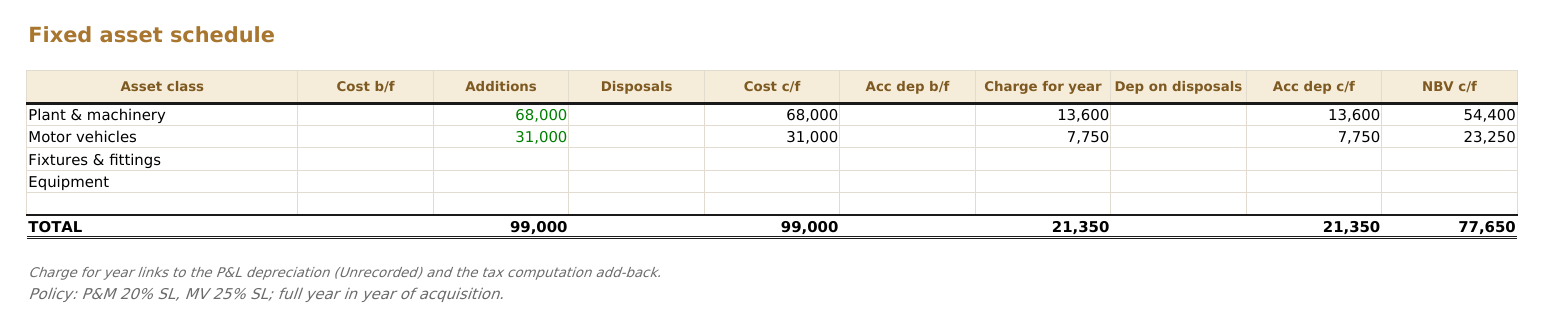
PrepIQ prepares a practice’s year-end working papers from the client’s records. Its fixed asset schedule carries cost, additions, disposals, the charge for the year and net book value by asset class, and the charge links to the depreciation in the profit and loss and to the add-back in the tax computation.

  • Cost and accumulated depreciation brought forward and carried forward
  • The charge for the year linked to the accounts
  • The add-back linked to the tax computation
Practice plans
PrepIQ · Fixed asset schedule
A PrepIQ fixed asset schedule: plant and machinery additions of £68,000 with a £13,600 charge and motor vehicles of £31,000 with a £7,750 charge, £21,350 in total, linked to the profit and loss and the tax computation

03

Capital allowances, linked to the tax

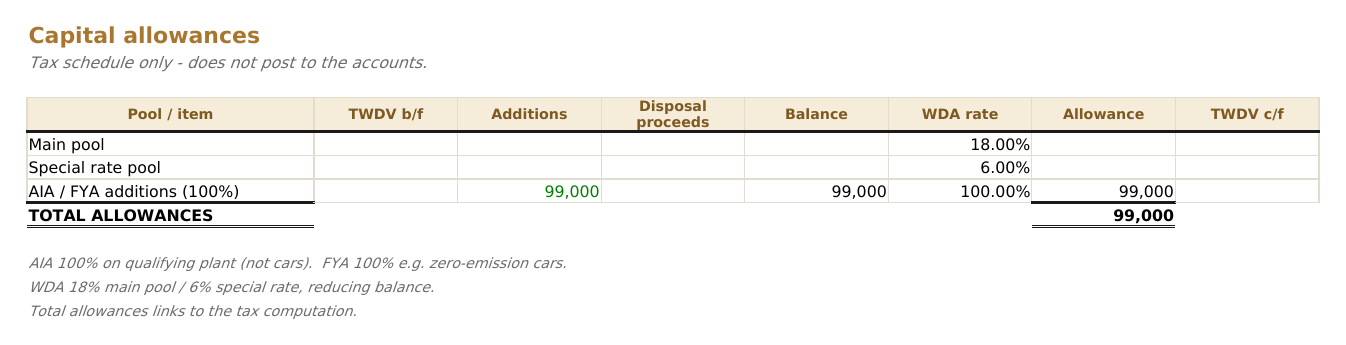
Alongside it, PrepIQ’s capital allowances schedule claims the Annual Investment Allowance and first-year allowances on additions, writes down the main and special rate pools, and carries the total into the corporation tax computation, where the depreciation is added back.

  • Annual Investment Allowance and first-year allowances on additions
  • Main and special rate pools on a reducing balance
  • Total allowances linked to the tax computation

More about PrepIQ year-end working papers. The example below is a year ended 31 March 2024, when the main pool rate was 18%.

PrepIQ · Capital allowances
A PrepIQ capital allowances schedule: main pool, special rate pool and £99,000 of additions claimed at 100% under the Annual Investment Allowance, total allowances linked to the tax computation

Guide

How to calculate depreciation

The two methods, the formulas, part years and journal entries, then how UK tax treats the same asset with capital allowances.

Depreciation meaning, in plain terms

Depreciation spreads the cost of an asset you will use for more than a year, a van, a machine, a laptop, over the years you use it, so each year’s profit carries its share. The asset goes on the balance sheet at cost; each year’s depreciation is a charge in the profit and loss, and the total so far, the accumulated depreciation, comes off the cost to give the net book value.

The depreciation formula: straight line

Annual depreciation = (cost − residual value) ÷ useful life

A machine that cost £12,000, expected to be worth £2,000 after 4 years, is depreciated by £10,000 ÷ 4 = £2,500 a year. Its net book value falls £12,000, £9,500, £7,000, £4,500, £2,000. The straight line rate is 1 ÷ useful life: 25% of the depreciable amount a year over 4 years.

The reducing balance method

The reducing balance formula is depreciation for the year = opening net book value × rate

At 25% a year, a £20,000 van is charged £5,000 in year one (leaving £15,000), £3,750 in year two (leaving £11,250) and £2,812.50 in year three. The charge falls every year because it is a percentage of a shrinking balance, which suits assets that lose value fastest when new. The book value never quite reaches zero; whatever is left is written off when the asset goes.

The reducing balance method formula for the rate

To find the rate that takes an asset from its cost to its residual value over its life:

Rate = 1 − (residual value ÷ cost)1 ÷ useful life

For the £12,000 machine worth £2,000 after 4 years, the rate is 1 − (2,000 ÷ 12,000)0.25 = 36.11%. Leave the rate blank in the calculator and it does this for you. With a residual value of nil there is no such rate, because a reducing balance never reaches zero, so you set the rate yourself.

Straight line vs reducing balance

Both charge the same total over the asset’s life, cost less residual value; they differ in timing. Straight line spreads it evenly; reducing balance front-loads it. Choose the method that matches how the asset is used up and apply it consistently to that class of asset. The chart above draws both for the same cost, life and residual value when it can.

Assets bought part way through the year

Businesses usually pick one of two policies: a charge for the months the asset was in use (bought with three months of the year left, a quarter of the annual charge), or a full year’s charge in the year of purchase and none in the year of sale. The calculator’s months-in-use box applies the first; on a straight line the charge you did not take in the first year falls into an extra final year.

Depreciation journal entries

Each period: debit depreciation expense in the profit and loss, credit accumulated depreciation on the balance sheet. When the asset is sold, remove its cost and its accumulated depreciation; the difference between the net book value and the sale proceeds is a profit or loss on disposal. Depreciation is not a cash movement: the cash went out when you bought the asset.

Depreciation vs capital allowances

UK tax does not allow depreciation. In the tax computation it is added back to the accounting profit, and capital allowances are deducted instead, on HMRC’s rules rather than your accounting policy. The capital allowances rates and rules in outline, from GOV.UK:

  • Annual Investment Allowance: the full cost of qualifying plant and machinery, up to £1 million a year, in the year you buy it. Not cars.
  • Full expensing: companies only, 100% on qualifying new and unused plant and machinery bought from 1 April 2023, or the 50% first-year allowance; not cars.
  • 40% first-year allowance: on new and unused plant and machinery that qualifies for the main rate, bought on or after 1 January 2026; not cars.
  • Writing down allowances: what is left goes into pools and is written down each year on a reducing balance: the main pool at 14% (18% before April 2026; the rate changed on 1 April 2026 for Corporation Tax and 6 April 2026 for Income Tax) and the special rate pool at 6%.

So a business that buys £12,000 of equipment may deduct all £12,000 for tax in year one under the Annual Investment Allowance while its accounts show £2,500 of depreciation. Our corporation tax calculator works out the tax on the profit that results.

Car depreciation and capital allowances on cars

This is a car depreciation calculator for your accounts: enter the car’s cost, the value you expect at the end and a rate (cars are often depreciated on a reducing balance), and it gives the book depreciation. It does not predict what a buyer would pay; resale value depends on the market, the model and the mileage.

For tax, cars do not get the Annual Investment Allowance. For cars bought from April 2021, GOV.UK sets the allowance by CO2 emissions: a new and unused zero-emission or electric car gets a 100% first-year allowance if bought before April 2027; a car at 50g/km or less, or a second-hand electric car, goes into the main pool at 14% (18% before April 2026); a car over 50g/km goes into the special rate pool at 6%. Sole traders and partners reduce the allowance for their private use. A van is not a car for capital allowances, so it can qualify for the Annual Investment Allowance.

Capital allowance rules checked against GOV.UK on 9 October 2026: Annual Investment Allowance, rates and pools, business cars, first-year allowances, full expensing and the 40% first-year allowance. The tax view assumes the Annual Investment Allowance is unused and the item is alone in its pool; your accountant has the final word on your own claim.
Worked examples

Two assets, in the accounts and for tax

Both businesses are VAT registered and reclaim the VAT, so the cost is before VAT. Type the same figures into the calculator above to follow along.

A joinery firm · straight line, bought mid-year

A £24,000 van

Bought with six months of the financial year left, used for 5 years, expected to sell for £4,000.

Depreciable amount (£24,000 − £4,000)£20,000.00
Annual charge (£20,000 ÷ 5)£4,000.00
Year 1 (6 months)£2,000.00
Years 2 to 5£4,000.00 a year
Year 6 (the remaining 6 months)£2,000.00
Net book value at the end£4,000.00

For tax, a van is plant, not a car, so the Annual Investment Allowance can cover all £24,000 in year one; the £2,000 of depreciation is added back.

A consultancy company · reducing balance

A £30,000 company car

Depreciated at 25% a year on a reducing balance. CO2 emissions of 45g/km, bought in an accounting period from April 2026.

Year 1 depreciation (£30,000 × 25%)£7,500.00
Year 2 (£22,500 × 25%)£5,625.00
Year 3 (£16,875 × 25%)£4,218.75
Year 1 capital allowance (main pool, 14%)£4,200.00
Main pool carried forward£25,800.00

The accounts charge £7,500; the tax computation adds that back and deducts £4,200. The car gets no Annual Investment Allowance.

Questions

Depreciation, answered

About working out depreciation, the two methods, capital allowances and cars, and what IQ Books does with your fixed assets.

How do I calculate depreciation?

Decide the cost, the residual value you expect at the end and the useful life, then pick a method. Straight line spreads the cost less the residual value evenly: (cost minus residual value) divided by the useful life gives the charge each year. Reducing balance charges a fixed percentage of the remaining book value each year, so the charge is largest in the first year. Enter the figures above and the calculator gives the charge for every year.

What is the depreciation formula?

For straight line: annual depreciation = (cost minus residual value) divided by useful life in years. For reducing balance: depreciation for the year = opening net book value times the rate. A £12,000 asset with a £2,000 residual value over 4 years is £2,500 a year on a straight line; at 25% reducing balance, a £20,000 asset is charged £5,000 in year one and £3,750 in year two.

What is straight line depreciation?

Straight line depreciation charges the same amount every year of an asset’s useful life, so the net book value falls in a straight line to the residual value. It suits assets that are used up evenly, such as office furniture, fixtures and many computers.

What is the reducing balance method?

The reducing balance method charges a fixed percentage of the asset’s net book value each year, so the charge is higher in the early years and falls each year after. It suits assets that lose value fastest when new, such as vehicles and some machinery. The book value never quite reaches zero; what is left is written off when the asset is sold or scrapped.

How do I work out a reducing balance rate?

Use rate = 1 minus (residual value divided by cost) to the power of 1 divided by the useful life. For a £12,000 asset expected to be worth £2,000 after 4 years, the rate is 1 minus (2,000 ÷ 12,000) to the power of a quarter, which is 36.11%. Leave the rate blank in the calculator and enter a useful life and residual value, and it works the rate out for you.

Straight line or reducing balance: which should I use?

Use the method that matches how the asset is used up. If it gives roughly the same benefit every year, straight line. If it loses most of its value early, as vehicles do, reducing balance. Whichever you choose, use it consistently for that class of asset, and review the useful life and residual value if things change.

How do I depreciate an asset bought part way through the year?

Many businesses charge depreciation for the months the asset was in use: an asset bought with six months of the year left gets half a year’s charge. Others charge a full year in the year of purchase and none in the year of sale. Pick a policy and apply it consistently. Enter the months in use in the first year and the calculator applies it, carrying the rest into an extra final year on a straight line.

What is the difference between depreciation and capital allowances?

Depreciation is the accounting charge that spreads an asset’s cost over its life in your accounts. UK tax does not allow depreciation; it is added back in the tax computation and replaced by capital allowances, which follow HMRC’s rules: the Annual Investment Allowance, first-year allowances and writing down allowances on pools. The two figures are usually different in any one year.

What are capital allowances?

Capital allowances are the tax relief a business gets on assets it buys to keep and use, such as machinery, equipment, vans and cars, in place of the depreciation in its accounts. The main ones are the Annual Investment Allowance (up to £1 million a year, not cars), first-year allowances, and writing down allowances: the main pool at 14% a year (18% before April 2026) and the special rate pool at 6%.

Can I claim depreciation for tax?

No. Depreciation in the profit and loss is added back to the profit when working out taxable profit, for companies and for sole traders. You claim capital allowances on qualifying assets instead, such as the Annual Investment Allowance of up to £1 million on plant and machinery other than cars.

What capital allowances can I claim on a car?

Cars do not qualify for the Annual Investment Allowance. For a car bought from April 2021, GOV.UK says a new and unused zero-emission or electric car gets a 100% first-year allowance (if bought before April 2027), a car with emissions of 50g/km or less goes in the main pool at 14% a year (18% before April 2026), and a car over 50g/km goes in the special rate pool at 6%. Sole traders reduce the allowance for private use.

What is the Annual Investment Allowance?

The Annual Investment Allowance lets a business deduct the full cost of qualifying plant and machinery from its profits in the year it buys it, up to £1 million a year. It does not cover cars, items you owned before using them in the business, or gifts. Companies buying new and unused plant can also claim full expensing.

How do I calculate car depreciation?

For your accounts, treat a business car like any other asset: pick a method, often reducing balance because cars lose value fastest when new, and enter the cost, the expected value at the end and the rate or life. That is book depreciation, not a resale valuation: what a buyer would pay depends on the market, the model and the mileage. For tax, a car gets capital allowances by its CO2 emissions instead.

Is depreciation a cash cost?

No. The cash leaves when you buy the asset; depreciation spreads that cost over the years you use it, so profit reflects the asset being used up. That is why a business can show lower profit than its cash suggests in the years after a big purchase, and why cash break-even calculations leave depreciation out.

Does this calculator store or send my figures?

No. Every calculation runs in your browser. Nothing you type is sent to ReconcileIQ or anyone else, and nothing is saved when you close the page.

Stop depreciating assets one at a time.

IQ Books keeps your fixed asset register and posts the depreciation every month, on the free plan with the whole ledger. Practices get the fixed asset and capital allowances schedules in every PrepIQ year-end set.