How Accounting Practices Move from Compliance to Advisory
The practical route from reconciliation-heavy bookkeeping to higher-value advisory work: standardise the workflow, automate the repetitive pieces, and protect senior capacity for conversations clients will actually pay for.

Most firms do not stay trapped in compliance because they lack ambition. They stay trapped because recurring work keeps swallowing the week. Reconciliations overrun, bookkeeping queues build up, senior reviewers keep dropping back into exception handling, and the capacity that was supposed to fund advisory quietly disappears into routine processing.
That means advisory growth is operational before it is commercial. If you want a practice that sells insight rather than just tidy files, you have to make the monthly workflow predictable first. Reconciliation, coding, and review need to become standardised, quicker, and less dependent on senior attention.
Quick answer
UK accounting practices grow advisory revenue by reducing the senior time consumed by compliance work, then redirecting that capacity into client conversations clients will pay for. The operational order matters: standardise the monthly workflow first (so every client closes on a predictable cadence), automate the repetitive layers (bank reconciliation, transaction coding, VAT classification) second, and then re-allocate the freed senior time to advisory third. ICAEW’s 2025 research on mid-tier firms shows fee growth at all 36 surveyed firms but also flags capacity constraints from regulatory complexity and skills shortages: the firms that compound fastest are the ones that invest in the workflow layer before they hire. ReconcileIQ handles bank-to-books matching across any platform, CodeIQ codes transactions and classifies VAT automatically, and LedgerIQ provides the analysis layer for advisory conversations. The IQ Suite’s own bookkeeping software, IQ Books, sits underneath as the ledger itself, so a practice can run capture, coding and reporting from one place.
of UK mid-tier firms surveyed by ICAEW (2025) reported fee growth in the last financial year, with new-client wins as the primary driver.
macro trends shaping practice growth in ICAEW’s 2025 research: private equity investment, evolving regulatory complexity, and generative AI.
biggest obstacles to growth flagged by surveyed firms: limited access to skills, and an increasingly complex regulatory landscape (ICAEW 2025).
Why reconciliation becomes the bottleneck
Manual bank reconciliation isn't just inefficient for a single business; it's exponentially challenging across a diverse client portfolio. Varying software, inconsistent data quality, different bank formats, and sheer volume turn reconciliation into a major operational bottleneck.
This bottleneck has significant costs:
- Lost Billable Hours: Time spent on manual matching is often low-value and difficult to fully bill for.
- Reduced Capacity: Limits the number of clients your team can effectively serve.
- Staff Burnout: Repetitive, tedious tasks contribute to fatigue and lower job satisfaction.
- Delayed Insights: Slow reconciliation means financial data isn't timely enough for proactive advice.
- Inconsistency: Manual processes are prone to errors and variations between team members.
“The challenge was twofold: spending too much time on compliance work that clients increasingly viewed as a commodity, while at the same time clients were asking for more strategic input the practice did not have time to deliver. Reconciliation, in particular, was the time sink that kept squeezing advisory capacity out of the calendar.”
A pattern reported across the 36 firms surveyed in ICAEW’s 2025 Evolution of Mid-Tier Accountancy Firms research, which found that 100% of firms reported fee growth alongside parallel pressure on capacity from regulatory complexity and skills shortages.
Why clients pay more for advice than tidy ledgers
The accounting landscape is evolving. Financial workflow automation is handling more traditional compliance tasks, pushing practices towards higher-value advisory services. This includes:
Helping clients anticipate and manage financial needs.
Providing insights into performance against goals and industry standards.
Assisting with planning for growth and profitability.
Guiding clients on efficient financial tools and systems.
Advisory services are not only what clients increasingly value, but they also command higher fees and create stickier client relationships. The challenge is finding the time to deliver them.
How automated reconciliation creates capacity
This is where modern, dedicated reconciliation tools come in. Unlike the basic reconciliation features within some accounting software, specialised platforms like ReconcileIQ are built to handle the complexity and volume faced by practices:
| Reconciliation Aspect | Traditional Practice Approach | Automated (ReconcileIQ) Approach |
|---|---|---|
| Data Handling | Manual export/import per client, dealing with varied formats. | Standardized upload (CSV/Excel) across all clients. Handles large files instantly. |
| Transaction Matching | Manual line-by-line checking per client (Hours per client). | Intelligent algorithm matches thousands of transactions across accounts (Minutes total). |
| Discrepancy Investigation | Time-consuming search for errors, timing differences, fees etc. | Automatically flags discrepancies, suggests likely matches, categorises issues. |
| Team Focus | Primarily focused on data entry and ticking/tying. | Focused on reviewing exceptions and providing insights. |
| Scalability | Linear increase in time/staff required per new client. | Minimal increase in time required per new client; easily handles growth. |

Benefits beyond time savings
Implementing automated reconciliation offers advantages that ripple throughout your practice:
Enhanced Accuracy & Consistency
Algorithms reduce human error and ensure a standardized process across all clients and team members.
Faster Month-End Close
Deliver timely financials to clients, enabling quicker decision-making and opening doors for advisory conversations.
Improved Scalability
Take on more clients without proportionally increasing headcount dedicated to reconciliation tasks.
Increased Team Satisfaction
Shift skilled staff from monotonous tasks to more engaging, analytical, and client-facing work.
Foundation for Tiered Services
Efficient compliance allows you to confidently price and deliver different service levels, including premium advisory packages.
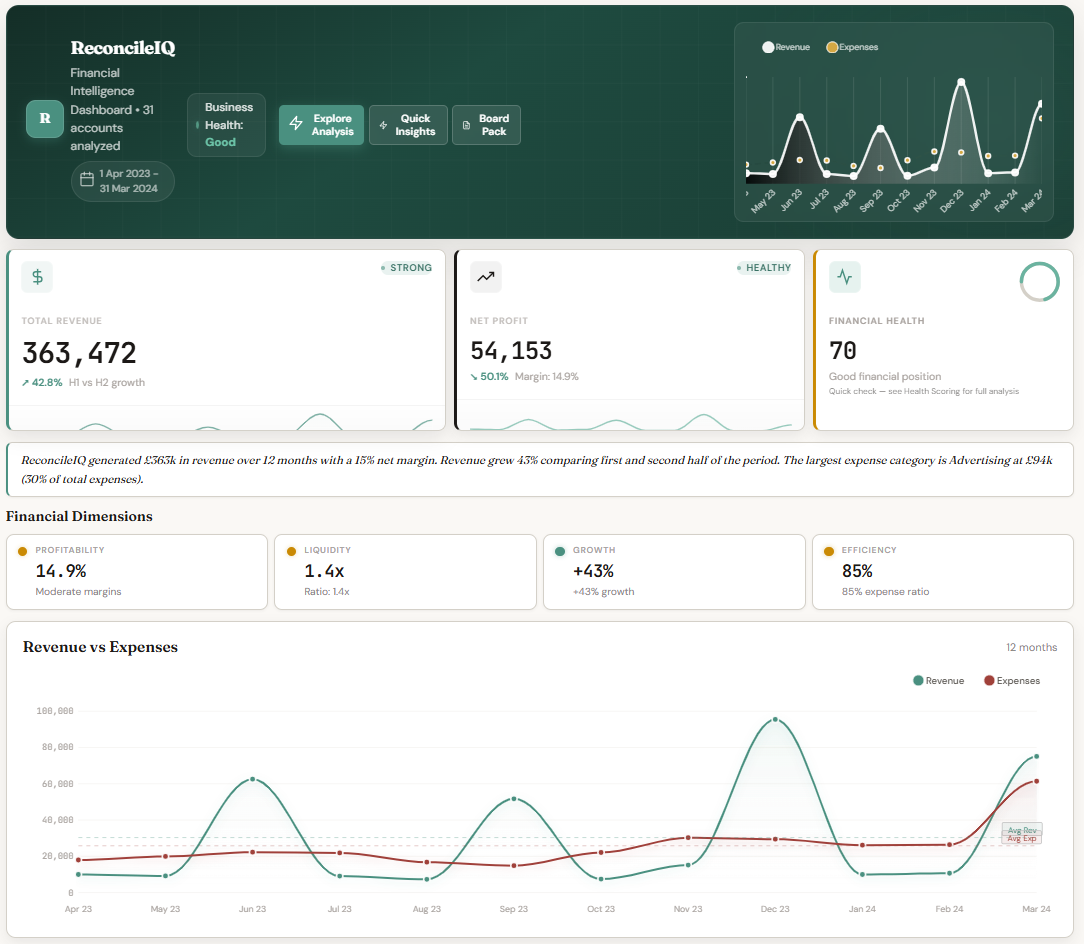
Transform Your Practice Efficiency with ReconcileIQ
Stop letting manual reconciliation dictate your practice's capacity and potential. ReconcileIQ is designed specifically for the needs of accountants and bookkeepers, handling unlimited clients and high transaction volumes with ease.
Reduce non-billable hours, standardize your reconciliation process, and free up your team's valuable time to focus on the strategic advisory work that drives growth and client satisfaction.
Frequently Asked Questions for Practices
How does ReconcileIQ handle multiple clients?
Our platform is built for multi-client management. You can easily process reconciliations for different clients without data overlap. The Business plan supports a high volume of transactions (20,000/month), suitable for managing numerous client accounts efficiently. Each reconciliation is handled separately by uploading the respective bank and book files.
Is it secure for handling sensitive client financial data?
Security is paramount. We use bank-level encryption (TLS/SSL for data in transit, AES-256 for data at rest where necessary). Uploaded files are processed immediately and typically deleted right after reconciliation results are generated. We are GDPR compliant and have strict data handling protocols designed for sensitive financial information.
Does ReconcileIQ replace our existing accounting software (Xero, QuickBooks, Sage, etc.)?
No, ReconcileIQ complements your existing accounting software. It's a specialised tool focused purely on the reconciliation step. You export the necessary transaction reports (as CSV/Excel) from your clients' accounting software and their bank, upload them to ReconcileIQ for rapid matching and discrepancy identification, and then make any necessary adjustments back in the primary accounting system.
What is the pricing model for accounting practices?
We offer straightforward pricing. The Business plan (£49.99/month) is typically the best fit for practices, offering a high transaction limit (20,000/month) sufficient for managing many clients. There are no per-client fees. You can try the tool for free to see how it fits your workflow before committing.
Unlock Your Practice's Potential
Transition your practice from reactive compliance to proactive advisory. Embrace automation to free up valuable resources, enhance client relationships, and build a more scalable, profitable future.
Start Streamlining Client Reconciliations TodayFrequently Asked Questions
How does automating reconciliation help build an advisory practice?
Automated reconciliation frees 5-8 hours per client per month that bookkeepers currently spend on manual matching. This capacity can be redirected to advisory services like cash flow forecasting, KPI reporting, and strategic financial planning.
What advisory services can accountants offer using automation?
With reconciliation and coding automated, practices can offer monthly management reporting, cash flow forecasting, financial health scoring, ratio analysis, budget vs actual tracking, and proactive tax planning as premium advisory packages.
Does ReconcileIQ replace existing accounting software?
No. ReconcileIQ complements your existing accounting software. It handles the reconciliation step specifically, working alongside Xero, QuickBooks, Sage, or any platform that exports transactions in CSV or Excel format.
What is the pricing model for accounting practices?
ReconcileIQ offers practice-focused plans with high transaction limits suitable for managing multiple clients. There are no per-client fees, making it cost-effective as your practice grows.