
Blog/Tax and MTD
Making Tax Digital for Landlords: the Dates, the Rules and the Software (2026)
Jack Whitehead·11 min read

Making Tax Digital for Income Tax reaches landlords by their rent before expenses. Over £50,000 meant starting in April 2026, over £30,000 means April 2027 and over £20,000 April 2028. Then you keep digital records, send four quarterly updates a year and file the tax return by 31 January.
Take Priya as an example. She lets three flats in Leeds through an agent, collects £38,400 of rent a year and pays mortgage interest on two of them. After the agent’s fees, the interest and a new boiler, her profit is modest. None of that matters to Making Tax Digital, because it looks at the rent before any of it comes off.
Her rent was over £30,000 in the 2025 to 2026 tax year, so from 6 April 2027 she has to keep her property records in MTD software and send HMRC an update every quarter. Her first update is due on 7 August 2027, and the tax return for that year goes in by 31 January 2029.
She is far from alone. HMRC’s own estimate, from 2023 to 2024 tax returns, is that 259,000 of the people in the first wave have property income: 118,000 with only landlord income and 141,000 with a business as well (HMRC statistics, August 2025).
People with property income joining MTD for Income Tax (HMRC estimate)
By August 2026 more than 436,000 sole traders and landlords had sent their first quarterly update (HMRC, 12 August 2026). The rest of this guide covers who is in, what you send and when, the rules for jointly owned property, the penalties, and what the software has to do.
Does Making Tax Digital apply to landlords?
Yes. MTD for Income Tax covers people registered for Self Assessment with income from self-employment, property, or both. Whether it applies to you, and from when, depends on your qualifying income on the tax return for an earlier year (gov.uk eligibility guidance).
| You use MTD from | If qualifying income was over | On the tax return for |
|---|---|---|
| 6 April 2026 | £50,000 | 2024 to 2025 |
| 6 April 2027 | £30,000 | 2025 to 2026 |
| 6 April 2028 | £20,000 | 2026 to 2027 |
Qualifying income is gross rent, what gov.uk calls turnover: the figure before mortgage interest, agent’s fees, repairs or anything else comes off (work out your qualifying income). A landlord who is also a sole trader adds the two together. Employment, pensions, dividends and a share of partnership profits are left out.
If you are UK tax resident, your UK and foreign property income both count. If you are not, your UK property income counts and your foreign property income does not, and anyone whose 2024 to 2025 return included the residence pages (SA109) is exempt until April 2027. For a jointly owned property only your share counts, so half of a house let for £30,000 puts £15,000 towards your total.
Three landlords, using their 2025 to 2026 figures, show how it works in practice.
| Landlord and income | Qualifying income | MTD from |
|---|---|---|
| Priya: £38,400 rent from three flats, plus a salary | £38,400 | 6 April 2027 |
| Tom: £24,000 rent from his own flat, plus half of a house let with his sister for £18,000 | £33,000 | 6 April 2027 |
| Sarah: her half of that house, £9,000 | £9,000 | Not in for April 2027; from April 2028 only if her 2026 to 2027 income tops £20,000 |
Some landlords are not in yet. Partnerships do not currently have to use MTD for Income Tax, and a partner’s share of profits does not count towards qualifying income. Trusts that file their own trust return (SA900) and personal representatives are exempt. A limited company that owns property pays Corporation Tax, so MTD for Income Tax does not apply to it.
MTD for landlords: start dates and deadlines
Every quarterly update is cumulative: it covers the tax year from 6 April to the end of that quarter, so the fourth repeats the whole year. The deadlines are the same every year (send quarterly updates).
| Update | Covers | Deadline |
|---|---|---|
| First | 6 April to 5 July | 7 August |
| Second | 6 April to 5 October | 7 November |
| Third | 6 April to 5 January | 7 February |
| Fourth | 6 April to 5 April | 7 May |
| Tax return | The whole year, with adjustments and other income | 31 January |
If you keep your accounts to 31 March, you can choose calendar quarters instead, ending 30 June, 30 September, 31 December and 31 March, but you must choose before you send your first update. The deadlines do not change. You can send an update any time after its quarter ends, or up to 10 days before the end if you have no further transactions to record for it.
Has MTD for landlords been delayed?
No. The first wave started on 6 April 2026, and as of 24 November 2026 gov.uk still gives 6 April 2027 for qualifying income over £30,000 and 6 April 2028 for over £20,000. If you are near a threshold, the year that decides it is the tax year that ended twelve months before your start date: for April 2027, the year to 5 April 2026.
What do landlords have to submit for MTD?
Three things: digital records through the year, four quarterly updates, and the tax return at the end. Each rent receipt and each expense needs a digital record with its amount, date and category, made as close to the date as you can, in the same categories as the property pages of a Self Assessment return (create digital records).
With UK property turnover under £90,000 you can keep your records in simpler categories, but a residential landlord must still mark which costs are finance costs, such as mortgage interest, because the tax relief on them is restricted. Keep the records, and the receipts and statements behind them, for at least five years after the 31 January deadline.
A spreadsheet is allowed, with bridging software that sends from it, as long as the two are digitally linked, with no retyping of figures from one into the other. Once a record has gone to HMRC, you must not move it by hand, within your software or into other software.
A quarterly update is the total of each income and expense category from 6 April to the end of the quarter. It is a running total, not a tax return, and you do not pay tax with it. All your UK lets are one UK property business, so they go in one update; foreign lets are a separate business with an update of their own, and one business’s updates must all come from the same software.
After the fourth update you make the year-end adjustments in your software: expenses that are not allowable, accounting adjustments (the cash basis is the default) and capital allowances. At the tax return you can claim the £1,000 property allowance instead of deducting your expenses. Rent-a-Room relief, for furnished rooms in your own home (up to £7,500, or £3,750 if shared), works differently: it is applied as you record that income during the year (adjust your income).
Then you add other income such as savings interest and dividends, check what HMRC already holds, such as your salary and pension, and submit the tax return through MTD software, or your accountant does as your main agent, by 31 January (submit your tax return). HMRC used to call this the final declaration.
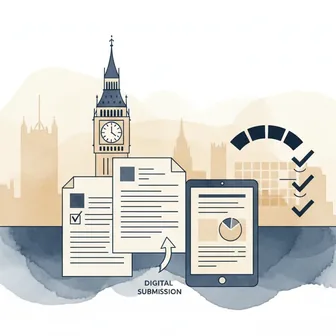
Jointly owned property under MTD

Joint owners report only their own share, and gov.uk eases the rules for them. For jointly let properties your quarterly updates can include either income and expenses, or income only. If you leave the expenses out, you report them after the year ends, by sending the fourth update again or adjusting the category totals. Expenses for properties you own outright still go in every quarter.
The records are lighter too. You only need digital records of your share, you can keep less detailed records, such as one record per category rather than one per transaction, and you do not need to link your records to the other owner’s. If you are only told your share after expenses have come off, HMRC uses that net figure for your qualifying income, but your records should still show the gross rent and the expenses.
Signing up, and who is exempt
You sign up through HMRC’s online service, or your accountant does it for you. You need to be registered for Self Assessment and to have filed a return in the last two years. From September 2026, HMRC started signing up people who should be using MTD for the 2026 to 2027 tax year and had not signed themselves up (sign up for MTD for Income Tax).
You are exempt automatically if your qualifying income is £20,000 or less, or if you did not have a National Insurance number before the tax year started. You can apply for an exemption if you are digitally excluded, meaning it is not reasonable for you to use compatible software; HMRC refuses applications that rest only on not being used to accounting software (exemptions).
MTD penalties for landlords
Late submissions earn points rather than an instant fine. Each missed deadline adds one point, and at 4 points you are charged £200, with another £200 for every further missed deadline while you are at the threshold. Points expire after 24 months if you stay below it (penalties for MTD for Income Tax).
If you start in April 2026 or April 2027, late quarterly updates earn no penalty points in your first tax year (2026 to 2027 for the first wave). A late tax return earns a point even in the first year.
Late payment is separate and not points-based: a percentage of any tax still unpaid 15 and 30 days after it was due, then a yearly rate on what remains. In your first year nothing is charged if you pay, or agree a payment plan, within 30 days, and payments on account are not penalised.
MTD software for landlords: what it has to do
You need software that works with MTD for Income Tax, and HMRC’s software finder lists it by the income it covers, including UK and foreign property. Beyond that, the questions that matter when you choose bookkeeping software for landlords are practical ones.
Does it handle UK and foreign property as two businesses, and put a jointly owned house in at your percentage? Does it use HMRC’s property categories with finance costs kept apart? Does it record a letting agent’s statement as the gross rent and the fees, not just the net payment that reached your bank?
Then the two questions that decide how your evenings go. Who does the bookkeeping: is the software a form you fill in each quarter, or does it bring in your bank lines and receipts and file them for you? And does it send the tax return as well, or quarterly updates only, with the year end going through other software or your accountant?
Free MTD software for landlords, and what the rest cost
Prices from each company’s own website, checked on 24 November 2026, before VAT. Offers change often, so check the price on the day you choose.
| Software | Free for landlords? | Paid plans from | Foreign property |
|---|---|---|---|
| IQ Books | Yes: UK or foreign property quarterly updates on the free plan, one set of books; the automatic coding and receipt reading use credits, 1,000 free | £10 a month (Starter, 5,000 credits a month) | Yes, as its own set of books |
| Clear Books | Yes: Property Free, one property or a group, quarterly updates and the tax return; no bank feeds or receipt scanning | £5 a month | Free for one overseas property |
| Landlord Studio | MTD Go: £0 a month for 1 to 3 units, £5 per MTD submission | £15 a month (£12 billed yearly) | MTD updates not yet available |
| RentalBux | Free for one property until March 2028, it says | Not shown | Yes |
| Hammock | 30-day trial | £8 a month (1 to 3 properties) | Not shown |
| FreeAgent | £0 introductory price with a qualifying NatWest, RBS, Ulster Bank or Mettle account; its page does not say whether that includes MTD filing | £10 a month (landlord plan) | Not shown |
| Xero | No | £7 a month (Simple) | A separate business with its own update |
Clear Books and FreeAgent say their software files the year-end tax return as well. Sage, QuickBooks and Landlord Vision also sell MTD software for landlords.
Which to pick comes down to how much of the work you want done for you. If you have one property, enter a handful of figures a quarter and want the tax return in the same place, a free form-style product does the job. If you have a portfolio, an agent, mortgages and a stream of receipts, the work is the bookkeeping, not the submission, and that is the part worth automating.
How IQ Books does MTD for landlords
IQ Books is an AI-native UK ledger that keeps the books itself: you review and sign off. Xero, QuickBooks and Sage sell you help with the bookkeeping, and you still do the bookkeeping. Connect your bank through BankSync and each line arrives coded to a landlord chart of accounts by CodeIQ’s eight-phase pipeline: rent, agent’s fees, repairs, insurance, ground rent, mortgage interest. Receipts and bills file themselves from a photo or an email.
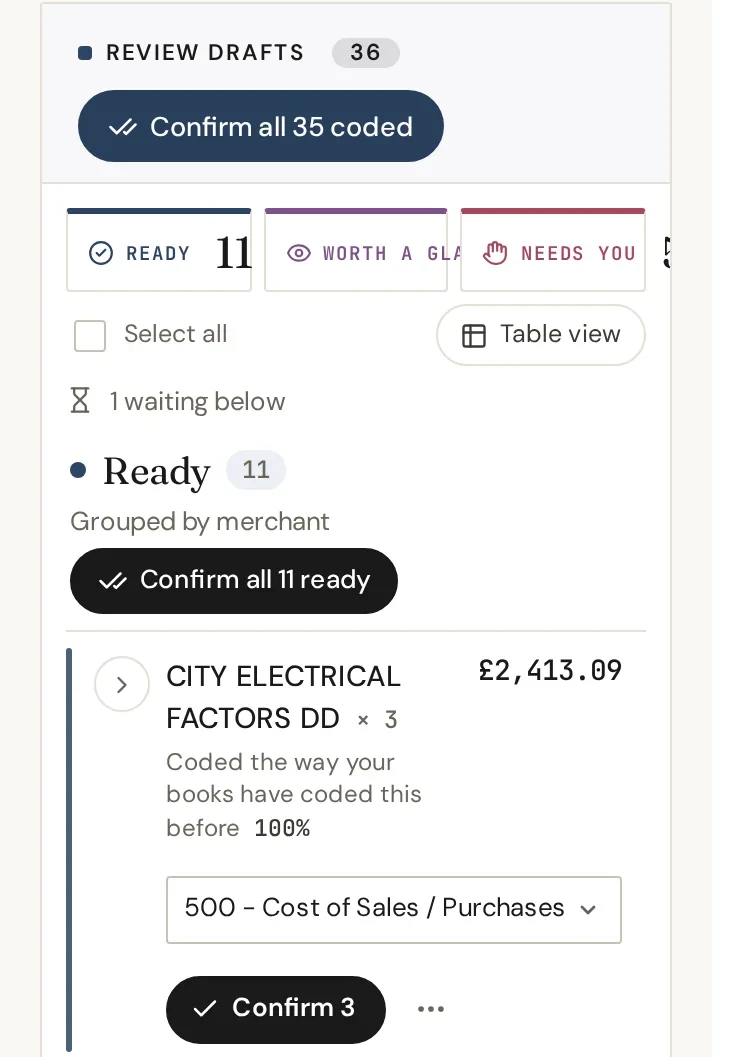
Each line is tagged to a property, with your ownership share set on each one: the books keep the full figures and the update sends your share. Everything goes in HMRC’s property categories, with mortgage interest kept apart as a finance cost and foreign tax kept apart for relief. The books run on the cash basis by default, checked against the basis HMRC holds for you; if the two differ, nothing is sent until you change it or confirm.
Before anything goes, it checks for the usual landlord mistakes: lines not tagged to a property, a repair of £2,000 or more that may really be an improvement, a tenant’s deposit counted as rent, agent rent posted net of the fees, and mortgage payments with no interest split out. It will not send more than 10 days before a quarter ends.
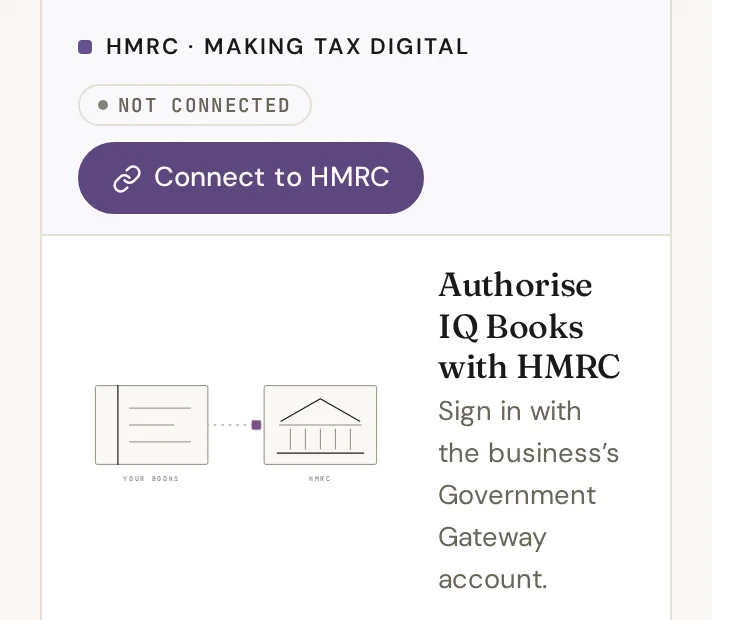
UK and foreign property quarterly updates have been live with HMRC since 20 November 2026, free on every plan. Where it stops, for now: the year-end tax return goes through other MTD software or your accountant, using the figures from your IQ Books records. For joint lets IQ Books sends your share of income and expenses every quarter, so it does not use the income-only option.
The free plan covers one set of books, and foreign lets or a sole-trader business are separate sets; a second set needs a paid plan, Starter at £10 a month plus £5 a month for each extra set. Bank feeds are a small monthly plan taken directly with BankSync, or you upload statements.
The automation uses credits, 4 a coded line and 10 a document read, with 1,000 free to start. IQ Books is UK only, and our MTD software page covers VAT and self-employment as well.
Questions people ask
Does Making Tax Digital apply to landlords?
Yes. MTD for Income Tax applies to landlords registered for Self Assessment whose qualifying income, meaning gross rent before expenses plus any self-employed turnover, was over £50,000 on the 2024 to 2025 return (from 6 April 2026), over £30,000 on the 2025 to 2026 return (from 6 April 2027) or over £20,000 on the 2026 to 2027 return (from 6 April 2028).
When does MTD start for landlords?
It depends on your qualifying income. Over £50,000 in 2024 to 2025: you started on 6 April 2026. Over £30,000 in 2025 to 2026: you start on 6 April 2027. Over £20,000 in 2026 to 2027: you start on 6 April 2028. At £20,000 or less you are exempt.
Has MTD for landlords been delayed?
No. The first wave started on 6 April 2026, and as of 24 November 2026 gov.uk still gives 6 April 2027 for qualifying income over £30,000 and 6 April 2028 for over £20,000.
Is the MTD threshold based on rent before or after expenses?
Before. Qualifying income is your gross rent, what gov.uk calls turnover, before mortgage interest, agent’s fees, repairs or any other expense. A landlord with £35,000 of rent and a small profit is still over the £30,000 threshold.
How does MTD work for jointly owned property?
Only your share counts towards your qualifying income, and you only need digital records of your share. For jointly let properties your quarterly updates can include income and expenses, or income only, with the expenses reported after the year ends by sending the fourth update again or adjusting the category totals. You can keep less detailed records, such as one per category, and do not need to link your records to the other owner’s.
What do landlords have to submit for MTD?
Digital records of rent and expenses through the year, four cumulative quarterly updates totalling each income and expense category from 6 April, and a tax return through MTD software by 31 January with the year-end adjustments, allowances and any other income. All UK lets are one business with one update; foreign lets have their own.
What are the MTD deadlines for landlords?
Quarterly updates are due on 7 August, 7 November, 7 February and 7 May, each covering the tax year from 6 April to the end of that quarter. The tax return is due by 31 January after the tax year ends.
What are the MTD penalties for landlords?
Each missed deadline earns a point, and at 4 points you pay £200, with another £200 for each further miss. If you start in April 2026 or April 2027, late quarterly updates earn no points in your first tax year, but a late tax return still earns one. Late payment penalties are separate: a percentage of tax still unpaid after 15 and 30 days, with 30 days’ grace in your first year.
Does foreign rental income count for MTD?
If you are UK tax resident, yes: UK and foreign property income both count towards your qualifying income, and foreign lets are a separate property business with their own quarterly update. If you are not UK resident, only your UK property income counts, and anyone whose 2024 to 2025 return included the residence pages (SA109) is exempt until April 2027.
Do I need MTD if I am a landlord and self-employed?
Add your gross rent and your self-employed turnover together; if the total is over the threshold, both are in. They are separate businesses for MTD, so each has its own quarterly updates, and one tax return covers the year.
Is there free MTD software for landlords?
Yes. IQ Books sends UK or foreign property quarterly updates on its free plan, with its automation drawing on 1,000 free credits. Clear Books’ Property Free covers one property or a group, including the tax return. Landlord Studio’s MTD Go costs nothing a month for 1 to 3 units but charges £5 per submission, and RentalBux says it is free for one property until March 2028 (prices checked 24 November 2026).
What is the best MTD software for landlords?
It depends on how much work you want the software to do. For one property and a few figures a quarter, a free form-style product is enough. For a portfolio with an agent, mortgages and receipts, choose software that brings in bank lines and receipts, tags them to each property and applies your share, as IQ Books does, and check whether it also files the year-end tax return.